A comprehensive interactive exploration of Optimisation AI — the solve pipeline, 8-layer stack, problem classes, LP/MIP/CP solvers, benchmarks, market data, and more.
~38 min read · Interactive ReferenceThe end-to-end workflow for solving optimisation problems — from problem definition through deployment and continuous re-optimisation.
Identify objectives, constraints, decision variables
Model as LP, MIP, CP, or nonlinear program
Execute solver engine; find optimal/near-optimal solution
Check feasibility, sensitivity analysis, stress-test
Embed in decision systems, APIs, dashboards
Track KPIs, retrigger on data changes
+------------------------------------------------------------------------+
| OPTIMISATION / OR PIPELINE |
| |
| 1. PROBLEM 2. MATHEMATICAL 3. SOLVE |
| DEFINITION FORMULATION |
| ---------------- ---------------- ---------------- |
| Define decision Translate to Apply exact solver |
| variables, objective objective function, (LP/MIP/CP) or |
| and constraints constraints, and heuristic to find |
| from business variable domains optimal/near-optimal |
| requirements solution |
| |
| 4. VALIDATE 5. DEPLOY 6. MONITOR |
| ---------------- ---------------- ---------------- |
| Verify solution Integrate solver Track solution quality, |
| feasibility and into operational re-optimise as data |
| business logic systems and conditions change |
+------------------------------------------------------------------------+
| Step | What Happens |
|---|---|
| Problem Definition | Identify decision variables (what can be changed), the objective (what to optimise), and constraints |
| Mathematical Formulation | Translate the business problem into a mathematical program: min/max f(x) subject to constraints g(x) |
| Data Preparation | Collect and validate input data (demand forecasts, costs, capacities, distances, time windows) |
| Solver Selection | Choose the appropriate algorithm: LP, MIP, CP, heuristic, or metaheuristic based on problem characteristics |
| Solution | Run the solver to find the optimal or near-optimal feasible solution |
| Validation | Verify solution feasibility, check business rule compliance, and compare to current practice |
| Sensitivity Analysis | Assess how the solution changes with perturbations to inputs (cost changes, demand shifts) |
| Deployment | Integrate the optimisation engine into production systems for automated or decision-support use |
| Re-Optimisation | Periodically re-solve as conditions change (rolling horizon, real-time re-optimisation) |
| Component | Definition | Example |
|---|---|---|
| Decision Variables | The quantities the solver decides; what you can control | Number of units to produce; which truck goes where |
| Objective Function | The quantity to minimise or maximise | Minimise total cost; maximise profit; minimise delay |
| Constraints | Conditions the solution must satisfy | Truck capacity <= 10 tons; deadline <= 5pm |
| Feasible Region | The set of all solutions satisfying all constraints | All valid production plans that meet capacity limits |
| Optimal Solution | The feasible solution with the best objective value | The lowest-cost delivery route that meets all deadlines |
| Optimality Gap | Difference between the best known solution and the theoretical lower/upper bound | Solution is within 1% of provably optimal |
UPS's ORION routing system saves 100 million miles driven and 10 million gallons of fuel per year.
Modern LP solvers like Gurobi can solve problems with millions of variables in seconds.
The travelling salesman problem — a classic OR challenge — has been exactly solved for up to 85,900 cities.
Test your understanding — select the best answer for each question.
Q1. What does LP stand for in operations research?
Q2. What is the travelling salesman problem (TSP)?
Q3. What does "constraint satisfaction" mean?
Click any layer to expand details about the components and technologies at each level.
| Layer | Name | Role | Key Technologies |
|---|---|---|---|
| 8 | Decision Interface | Present optimised decisions to users; scenario comparison and what-if tools | Dashboards, WebApps, ERP/WMS integration |
| 7 | Solution Delivery | Deploy optimisation as APIs, batch jobs, or embedded decision engines | Microservices, REST APIs, embedded solvers |
| 6 | Post-Processing | Validate, round, repair, and interpret solver output | Feasibility checks, sensitivity analysis, reporting |
| 5 | Solver Engine | Execute the algorithm to find optimal or near-optimal solutions | Gurobi, CPLEX, OR-Tools, SCIP, HiGHS, XPRESS |
| 4 | Model Formulation | Express the business problem as a mathematical program | Pyomo, PuLP, JuMP, AMPL, GAMS, CVXPY |
| 3 | Data & Parameters | Prepare input data: costs, demands, capacities, distances, time windows | ETL, databases, forecasting models |
| 2 | Prediction Layer | Use ML to forecast uncertain inputs (demand, travel time, prices) | XGBoost, Prophet, neural forecasters |
| 1 | Problem Identification | Define the business problem and success criteria | Domain expertise, stakeholder requirements |
The major classes of optimisation problems, each with distinct mathematical properties and solution methods.
Continuous decision variables with linear objectives and constraints. Solved in polynomial time via simplex or interior-point methods. Foundation of OR.
LP with some integer/binary variables. Branch-and-bound/cut solvers. Core of scheduling, logistics, and facility location.
Domain propagation and backtracking search over finite domains. Excels at scheduling, configuration, and highly combinatorial feasibility problems.
Minimise convex functions over convex sets. Guarantees global optimum. Includes quadratic, conic, and semidefinite programming.
Discrete search over finite but exponentially large solution spaces. TSP, graph colouring, bin packing, assignment problems.
Shortest path, max flow, min-cost flow, network design. Efficient specialised algorithms (Dijkstra, Ford-Fulkerson).
Decision-making under uncertainty with probabilistic parameters. Two-stage, multi-stage, chance-constrained, and robust formulations.
Simultaneous optimisation of conflicting objectives. Pareto front enumeration, weighted-sum, epsilon-constraint methods.
Sequential decisions over time with evolving state. Real-time re-optimisation, rolling-horizon, and online optimisation.
Worst-case optimisation over uncertainty sets. Immunises solutions against parameter perturbations without probability distributions.
| Sub-Type | Problem Structure | Classic Examples |
|---|---|---|
| Linear Programming (LP) | Linear objective, linear constraints, continuous variables | Resource allocation, blending, transportation |
| Mixed-Integer Programming (MIP) | LP with integer/binary variables | Facility location, scheduling, vehicle routing |
| Constraint Programming (CP) | Feasibility and optimisation with rich constraint types | Timetabling, job-shop scheduling, configuration |
| Convex Optimisation | Convex objective over convex feasible set | Portfolio optimisation, control, SVM training |
| Combinatorial Optimisation | Discrete decision space; find best combination | TSP, knapsack, graph colouring, bin packing |
| Network Optimisation | Optimisation over graph/network structures | Shortest path, max flow, min-cost flow, network design |
| Stochastic Optimisation | Optimisation under uncertainty with probabilistic inputs | Stochastic programming, robust optimisation |
| Multi-Objective Optimisation | Multiple conflicting objectives | Cost vs. service level, profit vs. risk |
| Dynamic Optimisation | Decisions unfold over time; state evolves | Inventory management, dynamic pricing, optimal control |
| Robust Optimisation | Find solutions that perform well under worst-case uncertainty | Supply chain design, financial hedging |
The algorithmic foundations underlying optimisation solvers and approaches.
Methods: Simplex, interior point
Continuous linear objectives and constraints. Polynomial-time solvable. Backbone of supply chain, blending, and resource allocation.
Methods: Branch-and-bound, branch-and-cut
Discrete variables for yes/no decisions. Scheduling, logistics, facility location. NP-hard but modern solvers handle millions of variables.
Methods: Domain propagation, backtracking search
Scheduling, configuration, rostering. Excels where feasibility is the core challenge and constraints are highly combinatorial.
Methods: Gradient descent, interior point
Guaranteed global optimum for convex problems. Quadratic, conic, and semidefinite programming. Portfolio optimisation, signal processing.
Methods: Sequential quadratic programming (SQP)
Non-convex objectives/constraints. Engineering design, chemical process optimisation. Local optima challenge.
Methods: Local search, simulated annealing, tabu search, genetic algorithms
Large-scale approximate solutions where exact methods are intractable. Vehicle routing, scheduling, layout optimisation.
Methods: Bellman recursion, memoisation
Sequential decision problems with overlapping subproblems. Inventory management, shortest paths, resource allocation over time.
The foundation of mathematical optimisation; models problems with linear objectives and constraints.
| Aspect | Detail |
|---|---|
| Core Mechanism | Minimise/maximise a linear objective subject to linear inequality/equality constraints |
| Algorithm | Simplex method (Dantzig, 1947); interior point methods |
| Key Property | Globally optimal solution guaranteed in polynomial time (interior point) or practical polynomial (simplex) |
| Used For | Resource allocation, blending, transportation, network flow, production planning |
| Scale | Modern solvers handle millions of variables and constraints |
| Aspect | Detail |
|---|---|
| Core Mechanism | LP extended with integer/binary decision variables — enables yes/no decisions, fixed costs, logical conditions |
| Algorithm | Branch-and-bound, branch-and-cut, branch-and-price; LP relaxation + intelligent enumeration |
| Key Property | NP-hard in general, but modern solvers exploit structure to solve large practical instances |
| Used For | Vehicle routing, facility location, scheduling, network design, workforce planning |
| Why It Matters | The workhorse of real-world optimisation; most practical problems require integer decisions |
| Aspect | Detail |
|---|---|
| Core Mechanism | Express problems as variables with domains and constraints; propagate constraints and search to find solutions |
| Algorithm | Constraint propagation, backtracking search, domain reduction |
| Key Advantage | Natural modelling of scheduling, sequencing, and feasibility problems; handles complex logical constraints |
| Used For | Job-shop scheduling, timetabling, rostering, configuration, puzzle solving |
| Key Solver | Google CP-SAT, IBM CPLEX CP Optimizer, Chuffed, Gecode |
| Aspect | Detail |
|---|---|
| Core Mechanism | Optimise a convex objective over a convex feasible set; any local optimum is the global optimum |
| Sub-Types | Quadratic programming (QP), second-order cone programming (SOCP), semidefinite programming (SDP) |
| Key Advantage | Efficient, globally optimal solutions with strong duality and sensitivity analysis |
| Used For | Portfolio optimisation, control, signal processing, machine learning (SVM training) |
| Key Solver | CVXPY, MOSEK, Gurobi (QP/SOCP), SCS |
| Aspect | Detail |
|---|---|
| Core Mechanism | Optimise nonlinear objectives and/or constraints |
| Algorithm | Sequential quadratic programming (SQP), interior point, augmented Lagrangian |
| Key Challenge | Multiple local optima; no guarantee of finding the global optimum |
| Used For | Chemical process optimisation, engineering design, optimal control, curve fitting |
| Key Solver | IPOPT, KNITRO, BARON (global), CONOPT |
| Method | Mechanism | Best For |
|---|---|---|
| Greedy Algorithms | Make locally optimal choices at each step | Fast approximations; initialisation for exact methods |
| Local Search / Hill Climbing | Iteratively improve a solution by exploring neighbours | Large-scale problems where exact methods are too slow |
| Simulated Annealing | Accept worse solutions probabilistically to escape local optima | Combinatorial problems with deceptive landscapes |
| Tabu Search | Local search with short-term memory to avoid revisiting solutions | Scheduling, routing, graph problems |
| Large Neighbourhood Search (LNS) | Destroy and repair portions of a solution iteratively | VRP, scheduling, planning — strong practical results |
| Variable Neighbourhood Search | Systematically change neighbourhood structures during search | Diverse combinatorial problems |
| GRASP | Greedy randomised construction + local search | Manufacturing, logistics, network design |
| Evolutionary / Genetic Algorithms | Population-based search (see Document #7) | Multi-objective, design, architecture search |
| Aspect | Detail |
|---|---|
| Core Mechanism | Break a problem into overlapping subproblems; solve each once and combine |
| Key Property | Optimal substructure and overlapping subproblems guarantee global optimality |
| Used For | Shortest path, inventory management, resource allocation, sequence alignment |
| Key Limitation | Curse of dimensionality — state space grows exponentially with dimensions |
| Modern Extensions | Approximate DP (ADP), neuro-dynamic programming (combining NN with DP) |
The major solvers, modelling languages, and platforms powering modern optimisation.
| Tool | Vendor | Key Differentiator |
|---|---|---|
| Gurobi | Gurobi | Industry-leading LP/MIP solver; fastest commercial solver |
| IBM CPLEX | IBM | Enterprise LP/MIP/CP; constraint optimisation at scale |
| FICO Xpress | FICO | Integrated solver + modelling for enterprise OR |
| MOSEK | MOSEK | Best-in-class conic/semidefinite optimisation |
| Google OR-Tools | Open-source vehicle routing, scheduling, constraint solving | |
| HiGHS | Open-source | High-performance open LP/MIP solver; Linux Foundation |
| SCIP | Zuse Institute | Leading academic MIP/MINLP solver |
| Pyomo | Sandia | Python optimisation modelling language |
| PuLP | Python | Simple LP/MIP Python interface |
| CVXPY | Stanford | Disciplined convex programming in Python |
| JuMP | Julia | Algebraic modelling in Julia; solver-agnostic |
| AMPL | AMPL | Industry algebraic modelling language |
| Solver | Type | Highlights |
|---|---|---|
| Gurobi | LP/MIP/QP | Industry-leading MIP solver; fastest on most benchmarks; Python/C/Java APIs |
| IBM CPLEX | LP/MIP/CP/QP | Enterprise solver; CP Optimizer for scheduling; IBM Decision Optimization |
| FICO Xpress | LP/MIP | Strong MIP solver; embedded in FICO analytics suite |
| MOSEK | LP/SOCP/SDP/QP | Specialised in conic optimisation; strong for portfolio and control problems |
| LocalSolver | Hybrid | Combines MIP, CP, and metaheuristics in a unified solver |
| Solver | Type | Highlights |
|---|---|---|
| Google OR-Tools | LP/MIP/CP/VRP | Comprehensive open-source optimisation suite; CP-SAT solver is world-class |
| HiGHS | LP/MIP/QP | High-performance open-source solver; increasingly competitive with commercial tools |
| SCIP | MIP/MINLP | Academic research solver; highly extensible; strong constraint propagation |
| CBC (COIN-OR) | LP/MIP | Open-source MIP solver; part of the COIN-OR project |
| GLPK | LP/MIP | GNU Linear Programming Kit; lightweight; good for education and small models |
| Chuffed | CP | Lazy clause generation CP solver; fast on scheduling problems |
| Tool | Language | Highlights |
|---|---|---|
| Pyomo | Python | Full-featured algebraic modelling; supports all major solvers |
| PuLP | Python | Lightweight LP/MIP modelling; good for education and prototyping |
| CVXPY | Python | Convex optimisation modelling; disciplined convex programming |
| JuMP | Julia | High-performance modelling; solver-independent; increasingly popular in OR |
| AMPL | Custom | Industry-standard algebraic modelling language; supports all commercial solvers |
| GAMS | Custom | General Algebraic Modeling System; strong in energy and economic modelling |
| Google OR-Tools (Python) | Python | Python API for CP-SAT, routing, linear assignment, network flows |
| OptaPlanner | Java/Kotlin | Open-source constraint solver for planning; Red Hat sponsored |
| Platform | Provider | Highlights |
|---|---|---|
| Gurobi Machine Learning | Gurobi | Embed ML models inside MIP formulations for integrated predict-optimise |
| IBM Decision Optimization | IBM | CPLEX-powered; integrated into Cloud Pak for Data; ML + optimisation |
| AIMMS | AIMMS | Modelling platform with prescriptive analytics focus |
| Nextmv | Nextmv | Decision engineering platform; versioning, testing, and deploying OR models |
| Google Cloud Optimization AI | Managed fleet routing optimisation service | |
| Amazon Optimization | AWS | Route optimisation and supply chain planning services |
How Optimisation / OR AI drives measurable impact across logistics, manufacturing, and supply chain.
| Example | Detail |
|---|---|
| UPS ORION | Saves 100M+ miles/year optimising delivery routes for 100k+ drivers |
| Amazon Routing | Real-time route optimisation across last-mile delivery network |
| Google Cloud OR | Cloud Fleet Routing API for scalable vehicle routing as a service |
| Example | Detail |
|---|---|
| Amazon | Fulfilment centre placement optimising delivery speed and cost |
| Walmart | Distribution network design covering 4,700+ US stores |
| DHL | Global facility placement balancing service levels and cost |
| Example | Detail |
|---|---|
| Blue Yonder | AI-driven inventory planning across retail and manufacturing |
| o9 Solutions | Integrated demand-supply planning with optimisation engine |
| RELEX Solutions | Retail inventory and supply chain optimisation platform |
| Example | Detail |
|---|---|
| Siemens | Manufacturing execution with advanced scheduling optimisation |
| SAP APO | Advanced Planning & Optimisation for production and distribution |
| AspenTech | Process industry scheduling for chemicals, oil & gas |
| Example | Detail |
|---|---|
| LLamasoft (Coupa) | End-to-end supply chain network modelling and optimisation |
| Kinaxis | Concurrent planning with optimisation across supply chain tiers |
| Example | Detail |
|---|---|
| ORTEC | 3D load building and vehicle/container packing optimisation |
| FarEye | Last-mile logistics with load optimisation and route planning |
| Use Case | Description | Key Examples |
|---|---|---|
| Vehicle Routing (VRP) | Route fleets of vehicles to serve customers at minimum cost | UPS ORION, Amazon routing, Google Cloud OR |
| Warehouse Location | Decide where to open warehouses to minimise cost and maximise service | Amazon fulfilment network, Walmart, DHL |
| Inventory Optimisation | Set stock levels that balance holding costs and stockout risk | Blue Yonder, o9 Solutions, Relex Solutions |
| Production Scheduling | Schedule manufacturing operations to minimise makespan and tardiness | Siemens, SAP APO, AspenTech |
| Supply Chain Network Design | Optimise the end-to-end supply chain structure (plants, warehouses, flows) | LLamasoft (Coupa), Llamasoft, Kinaxis |
| Load Planning / Container Packing | Optimise how goods are packed into containers and trucks | 3D bin packing, ORTEC, FarEye |
| Use Case | Description | Key Examples |
|---|---|---|
| Airline Crew Scheduling | Schedule crews for flights while satisfying labour and regulatory rules | SABRE, Jeppesen (Boeing), Amadeus |
| Flight Network Planning | Design airline route networks and fleet assignment | Boeing, Airbus, airline operations research |
| Rail Scheduling | Optimise train timetables, platform assignment, and crew rosters | DB Cargo, SNCF, Network Rail |
| Ride-Sharing Dispatch | Match riders to drivers and optimise routes in real time | Uber, Lyft, Grab OR systems |
| Use Case | Description | Key Examples |
|---|---|---|
| Portfolio Optimisation | Allocate assets to maximise return for a given risk level (Markowitz) | BlackRock Aladdin, Bloomberg PORT, MSCI |
| Risk Budgeting | Allocate risk budget across assets or business units | Risk parity, CVaR optimisation |
| Trade Execution Optimisation | Minimise market impact and transaction costs when executing large trades | Algorithmic execution, VWAP/TWAP optimisation |
| Cash Flow Optimisation | Optimise payment timing and cash positions across accounts | Treasury management, Kyriba, TIS |
| Use Case | Description | Key Examples |
|---|---|---|
| Network Design | Optimise placement of towers, fibre routes, and network topology | AT&T, Verizon, Deutsche Telekom OR teams |
| Frequency Assignment | Assign spectrum frequencies to avoid interference | Graph colouring models; Ofcom, FCC allocation |
| Capacity Planning | Allocate network capacity to meet demand forecasts | Ericsson, Nokia network planning tools |
| Use Case | Description | Key Examples |
|---|---|---|
| Operating Room Scheduling | Schedule surgeries across rooms, teams, and equipment | Hospital OR departments, Optum |
| Nurse / Staff Rostering | Create shift schedules satisfying labour rules and demand coverage | ShiftWizard, QGenda, Kronos |
| Radiotherapy Treatment Planning | Optimise radiation beam angles and intensities to maximise tumour dose and minimise healthy tissue exposure | Varian, Elekta, RaySearch |
| Ambulance Positioning | Position ambulances to minimise response time across a region | Emergency service optimisation |
| Use Case | Description | Key Examples |
|---|---|---|
| Power Grid Dispatch | Optimise which generators to turn on and at what level (unit commitment) | ISO/RTO dispatch, GE Vernova, Siemens |
| Renewable Integration | Schedule storage and demand response to balance variable renewable supply | Battery optimisation, Tesla Autobidder |
| Pipeline Network Optimisation | Optimise flow through oil/gas pipeline networks | DNV, Schlumberger, AspenTech |
| EV Charging Station Placement | Optimise locations for EV charging infrastructure | Utility planning, municipal optimisation |
Solver performance comparisons and standard benchmark suite coverage.
| Metric | What It Measures |
|---|---|
| Objective Value | The value of the objective function at the solution; the primary quality measure |
| Optimality Gap | Percentage difference between the best known solution and the theoretical bound |
| Feasibility | Whether all constraints are satisfied; a solution is useless if infeasible |
| Constraint Violation | Magnitude of any constraint breaches in relaxed solutions |
| Improvement over Baseline | How much better the optimised solution is compared to current practice or naive heuristics |
| Metric | What It Measures |
|---|---|
| Solve Time | Wall-clock time to find and prove a solution; critical for real-time systems |
| Time to Best Solution | When the best solution was found — important even if proving optimality is slow |
| Node Count | Number of branch-and-bound nodes explored; proxy for search difficulty |
| LP Relaxation Quality | How tight the LP relaxation bound is; tighter = faster proof of optimality |
| Scalability | How solve time grows with problem size (variables, constraints) |
| Benchmark | Domain | Description |
|---|---|---|
| MIPLIB | Mixed-Integer Programming | Standard benchmark library for MIP solvers; 240+ instances |
| TSPLIB | Routing | Classic TSP and VRP benchmark instances |
| DIMACS | Graph problems | Standard graph optimisation benchmarks (colouring, clique, flow) |
| CSPLib | Constraint programming | Library of constraint satisfaction problem benchmarks |
| Minizinc Challenge | Constraint modelling | Annual competition for CP solvers on diverse problem types |
| Hans Mittelmann Benchmarks | LP/MIP/SOCP/SDP | Independent solver benchmarks; widely referenced for solver comparison |
| CVRPLIB | Vehicle routing | Capacitated VRP benchmark instances |
Market sizing and growth projections for the Optimisation / OR AI ecosystem.
| Metric | Value | Source / Notes |
|---|---|---|
| Global Operations Research / Optimisation Market (2024) | ~$12.4 billion | Includes software, services, and consulting across all OR applications |
| Projected Market Size (2030) | ~$31.0 billion | CAGR ~16%; driven by supply chain, logistics, and AI integration |
| Supply Chain Optimisation Software (2024) | ~$5.8 billion | Largest sub-segment; includes routing, inventory, and network design |
| Mathematical Optimisation Solvers (2024) | ~$1.2 billion | Commercial solver market (Gurobi, CPLEX, FICO Xpress, MOSEK) |
| Decision Intelligence Market (ML + OR) (2024) | ~$3.1 billion | Fastest-growing segment; convergence of ML prediction + OR optimisation |
| Segment | Leaders | Challengers |
|---|---|---|
| Commercial Solvers | Gurobi, IBM CPLEX, FICO Xpress | MOSEK, LocalSolver, KNITRO |
| Open-Source Solvers | Google OR-Tools (CP-SAT), HiGHS, SCIP | CBC, GLPK, Chuffed |
| Supply Chain Optimisation | Blue Yonder, o9 Solutions, Kinaxis | Coupa, Relex, GAINS |
| Fleet Routing | Google Cloud OR, ORTEC, Descartes | Routific, OptimoRoute, Route4Me |
| Modelling Languages | Pyomo, AMPL, GAMS, JuMP | PuLP, CVXPY, OptaPlanner |
| Decision Intelligence Platforms | Gurobi ML, IBM Decision Optimization, Nextmv | AIMMS, Satalia (WPP), DecisionBrain |
Key challenges and pitfalls in deploying Optimisation / OR AI systems.
NP-hard problems may be computationally infeasible at scale; solver time can explode with small increases in problem size.
Mathematical models inevitably oversimplify reality; critical real-world constraints may be omitted or linearised away.
Garbage parameters produce garbage solutions — cost coefficients, demand forecasts, and capacity data must be accurate.
Deterministic models ignore real-world stochasticity; solutions may be fragile under parameter deviations.
Small growth in problem dimensions can cause exponential growth in solve time, creating sudden performance cliffs.
Optimising the wrong objective function perfectly still yields the wrong answer — objective design is critical and often underinvested.
| Limitation | Description |
|---|---|
| Computational Intractability | Many real-world problems (MIP, VRP, scheduling) are NP-hard; solving to proven optimality may be infeasible |
| Model Fidelity | The mathematical model is always a simplification of reality; oversimplification leads to poor decisions |
| Data Quality Dependence | Optimisation is only as good as its input data — garbage in, garbage out |
| Uncertainty Handling | Deterministic models ignore uncertainty; stochastic and robust methods add complexity |
| Scalability Cliffs | Small increases in problem size can cause exponential increases in solve time |
| Objective Misalignment | Optimising the wrong objective (or missing constraints) can produce technically optimal but practically bad decisions |
| Implementation Gap | A mathematically optimal solution may be rejected by operators who distrust or do not understand it |
| Dynamic Environments | Solutions computed offline may become stale as conditions change in real time |
| Risk | Description |
|---|---|
| Workforce Impact | Optimised schedules and resource plans may reduce headcount or intensify workloads |
| Fairness in Allocation | Resource allocation models may distribute resources inequitably across regions or groups |
| Automation of High-Stakes Decisions | Fully automated optimisation in healthcare, justice, or finance carries accountability risks |
| Transparency | Complex MIP models with thousands of constraints are difficult to explain to non-technical stakeholders |
Explore how this system type connects to others in the AI landscape:
Evolutionary / Genetic AI Reinforcement Learning AI Analytical AI Autonomous AI Scientific / Simulation AIEssential Optimisation / Operations Research AI terminology.
| Term | Definition |
|---|---|
| Branch-and-Bound | An exact algorithm that explores a search tree, pruning branches that cannot improve on the best known solution |
| Branch-and-Cut | Branch-and-bound enhanced with cutting planes that tighten the LP relaxation at each node |
| Combinatorial Optimisation | Optimisation over a discrete, finite (but often exponentially large) set of feasible solutions |
| Constraint | A condition that a feasible solution must satisfy; defines the boundary of the solution space |
| Constraint Programming (CP) | A paradigm that solves problems by propagating constraints and searching over reduced variable domains |
| Convex Optimisation | Optimisation where the objective and feasible set are convex; any local optimum is the global optimum |
| Decision Variable | A variable whose value is determined by the solver; represents a choice or decision |
| Dual Problem | A related optimisation problem that provides bounds on the original (primal) problem's objective |
| Dynamic Programming | A method for solving problems by decomposing them into overlapping subproblems solved recursively |
| Feasible Region (Feasible Set) | The set of all solutions that satisfy all constraints |
| Heuristic | A problem-specific algorithm that finds good (but not provably optimal) solutions efficiently |
| Integer Programming (IP) | Optimisation where some or all decision variables are restricted to integer values |
| Large Neighbourhood Search (LNS) | An iterative improvement method that destroys and rebuilds portions of a solution |
| Linear Programming (LP) | Optimisation of a linear objective function subject to linear constraints with continuous variables |
| LP Relaxation | The LP obtained by dropping integrality constraints on integer variables; provides a bound on the MIP optimal |
| Metaheuristic | A high-level, problem-independent strategy for guiding search (simulated annealing, tabu search, genetic algorithms) |
| Mixed-Integer Programming (MIP) | LP with some variables constrained to be integers; the workhorse of practical optimisation |
| Objective Function | The mathematical function to be minimised or maximised |
| Optimal Solution | A feasible solution with the best possible objective value; no other feasible solution is better |
| Optimality Gap | The relative difference between the best known feasible solution and the best known bound on the optimal value |
| Operations Research (OR) | The discipline of applying analytical and mathematical methods to help make better decisions |
| Pareto Front | The set of solutions in multi-objective optimisation where no objective can be improved without worsening another |
| Prescriptive Analytics | Analytics that recommends actions — the intersection of prediction (what will happen) and optimisation (what to do) |
| Relaxation | A simplified version of a problem obtained by removing some constraints; used to compute bounds |
| Sensitivity Analysis | Study of how changes in input parameters affect the optimal solution and objective value |
| Simplex Method | The classic algorithm for solving LP; pivots along vertices of the feasible polytope |
| Solver | Software that finds optimal or near-optimal solutions to mathematical optimisation problems |
| Stochastic Optimisation | Optimisation under uncertainty; models uncertain parameters as random variables with known distributions |
| Vehicle Routing Problem (VRP) | The problem of finding optimal routes for a fleet of vehicles serving a set of customers |
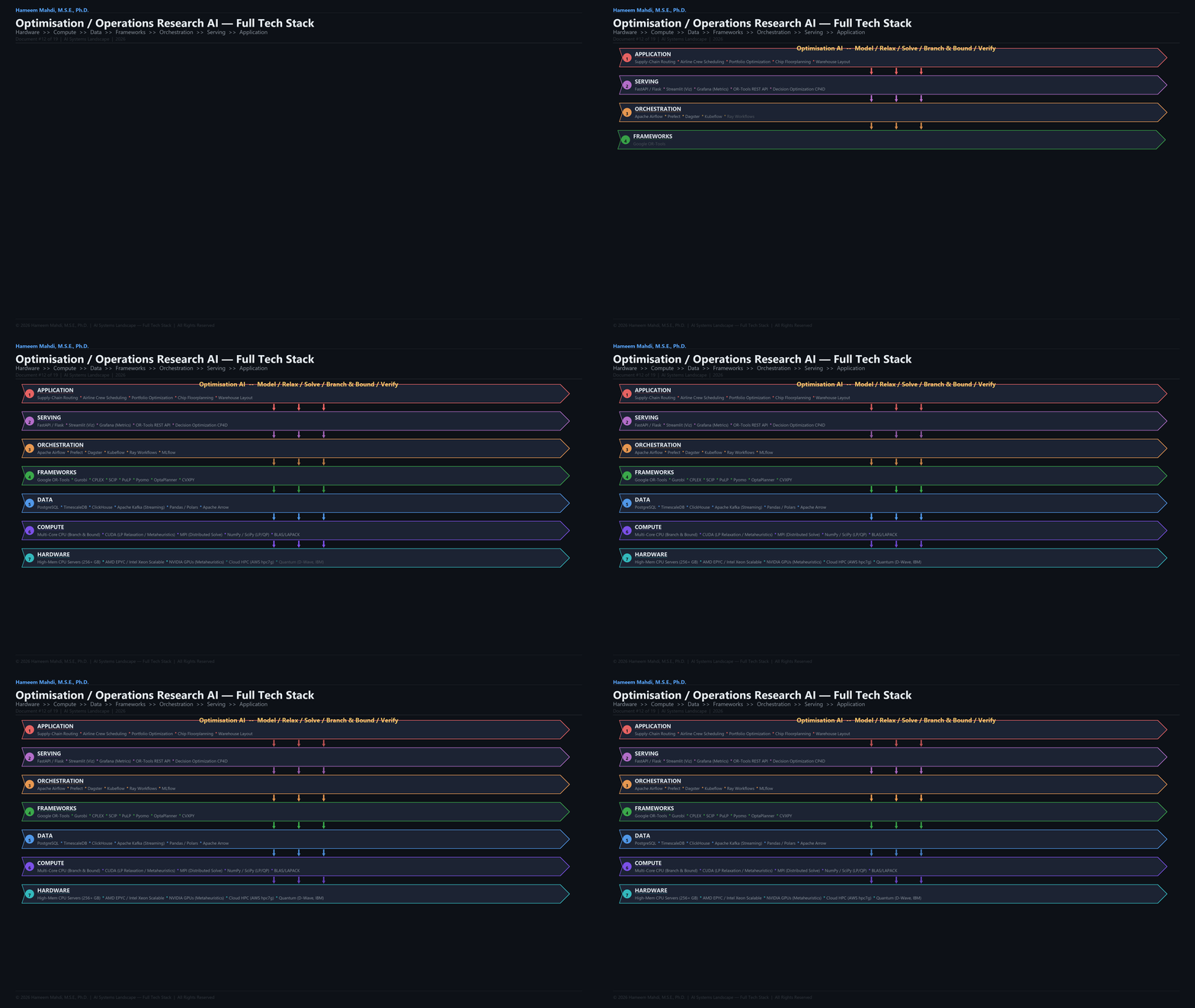
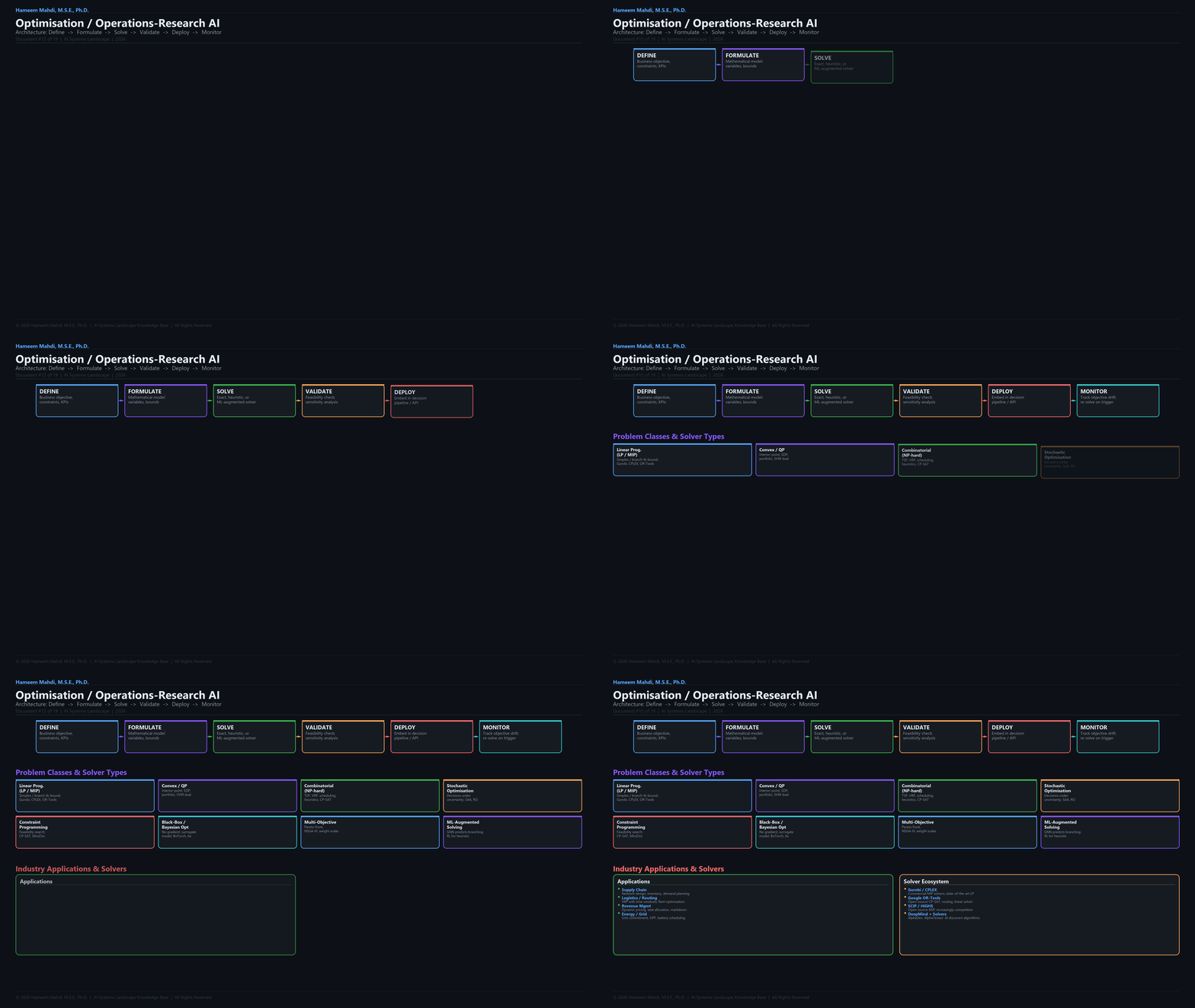
Animation infographics for Optimisation / Operations Research AI — overview and full technology stack.
Animation overview · Optimisation / Operations Research AI · 2026
Animation tech stack · Hardware → Compute → Data → Frameworks → Orchestration → Serving → Application · 2026
Detailed reference content for regulation.
Optimisation AI intersects with regulation primarily when it makes or informs high-stakes decisions:
| Domain | Regulatory Considerations |
|---|---|
| Energy Markets | Dispatch optimisation subject to energy market rules and grid reliability standards (FERC, ENTSO-E) |
| Financial Services | Portfolio optimisation and trading algorithms subject to market regulation (SEC, FCA, MiFID II) |
| Transportation | Route and schedule optimisation must comply with driver hour regulations, safety rules, and environmental law |
| Healthcare | Treatment planning optimisation (e.g., radiotherapy) subject to medical device regulation (FDA, MDR) |
| Labour / Workforce | Staff scheduling must comply with labour laws, equity regulations, and union agreements |
| EU AI Act | Optimisation systems used in high-risk domains (employment, critical infrastructure) subject to documentation and transparency requirements |
| Antitrust | Collaborative optimisation between competitors (e.g., shared logistics) may raise competition law concerns |
Detailed reference content for deep dives.
| Problem | Description | Complexity | Applications |
|---|---|---|---|
| Travelling Salesman Problem (TSP) | Find the shortest route visiting all cities exactly once and returning to start | NP-hard | Delivery routing, PCB drilling, DNA sequencing |
| Vehicle Routing Problem (VRP) | Route a fleet of vehicles to serve customers at minimum cost | NP-hard | Logistics, last-mile delivery, field service |
| Bin Packing | Pack items into bins using the fewest bins possible | NP-hard | Container loading, memory allocation, cutting |
| Knapsack Problem | Select items to maximise value within a weight/capacity limit | NP-hard | Budget allocation, cargo loading, project selection |
| Job-Shop Scheduling | Schedule jobs on machines to minimise makespan or tardiness | NP-hard | Manufacturing, operating room scheduling |
| Graph Colouring | Assign colours to vertices so no adjacent vertices share a colour | NP-hard | Register allocation, frequency assignment, scheduling |
| Facility Location | Choose where to open facilities and assign customers to minimise total cost | NP-hard | Warehouse placement, hospital location, retail |
| Set Cover / Covering | Find minimum-cost set of resources that cover all requirements | NP-hard | Crew scheduling, sensor placement, test coverage |
| Approach | Description |
|---|---|
| Branch-and-Cut | Combine branch-and-bound with cutting planes to tighten LP relaxations |
| Column Generation | Solve large LP/MIP by generating promising variables (columns) on demand |
| Benders Decomposition | Decompose large problems into a master problem and subproblems |
| Large Neighbourhood Search (LNS) | Iteratively destroy and repair portions of a solution; state-of-the-art for VRP |
| Neural Combinatorial Optimisation | Train neural networks to generate or improve solutions (attention-model TSP solvers) |
| Hybrid ML + OR | Use ML to predict solver parameters, warm-start solutions, or learn branching rules |
| Concept | Description |
|---|---|
| Variable | A decision to be made; has a domain of possible values |
| Domain | The set of possible values for a variable (integer range, set of options) |
| Constraint | A relation that must hold between variables (e.g., x != y, start + duration <= deadline) |
| Propagation | Systematically reduce variable domains by enforcing constraints |
| Search | Explore reduced search space via intelligent backtracking |
| Global Constraints | High-level constraints with efficient propagation (AllDifferent, Cumulative, Circuit) |
| Criterion | Constraint Programming | Mixed-Integer Programming |
|---|---|---|
| Problem Type | Scheduling, sequencing, feasibility | Resource allocation, network design, planning |
| Constraint Style | Complex logical, disjunctive, global | Linear and piecewise linear |
| Objective | Feasibility or optimisation | Optimisation with provable bounds |
| Strengths | Rich constraint expressiveness; fast feasibility | Tight LP relaxations; strong optimality proofs |
| Weaknesses | Weaker objective bounds | Difficulty with complex logical constraints |
| Best Practice | Many modern solvers (CP-SAT, CPLEX) combine both approaches |
The convergence of machine learning and operations research is one of the most impactful trends in applied AI.
| Pattern | Description | Example |
|---|---|---|
| Predict-then-Optimise | Use ML to forecast inputs, then solve deterministic optimisation with those predictions | Forecast demand (ML) then optimise inventory (MIP) |
| ML for Solver Acceleration | Train ML models to learn branching rules, cut selection, or node selection inside solvers | Learn2Branch, Ecole framework |
| ML for Solution Initialisation | Use ML to predict warm-start solutions for the solver | Predict initial facility locations, then optimise |
| End-to-End Differentiable Optimisation | Embed optimisation layers inside neural networks for joint training | OptNet, cvxpylayers, differentiable LP/QP layers |
| Neural Combinatorial Solvers | Train neural networks to directly output solutions to combinatorial problems | Pointer Networks, Attention Model for TSP/VRP |
| Reinforcement Learning for Optimisation | Use RL to learn construction or improvement heuristics | RL for vehicle routing, scheduling, bin packing |
| Surrogate-Assisted Optimisation | Replace expensive simulations with ML surrogates to speed up optimisation loops | Bayesian optimisation, simulation-based design |
| System / Paper | Contribution |
|---|---|
| Ecole (Gasse et al.) | OpenAI Gym-like environment for learning to configure and accelerate MIP solvers |
| OptNet (Amos & Kolter) | Differentiable QP solver as a neural network layer |
| Attention Model (Kool et al.) | Transformer-based model that learns to solve routing problems via attention |
| Google Chip Design (Mirhoseini et al.) | RL-based approach to chip floorplanning; published in Nature |
| DeepMind for MIP (Nair et al.) | Neural diving and branching for accelerating MIP solving |
Detailed reference content for overview.
Optimisation and Operations Research (OR) AI is the branch of artificial intelligence and applied mathematics focused on systems that find optimal or near-optimal solutions to well-defined mathematical problems subject to constraints. It answers the question: given limited resources, conflicting objectives, and operational constraints, what is the best possible decision?
OR is one of the oldest and most impactful computational disciplines, predating modern AI by decades. It was formalised during World War II to optimise military logistics and has since become the backbone of modern supply chains, airline operations, telecommunications networks, financial portfolio management, and manufacturing scheduling. The convergence of OR with machine learning — what is now called ML-augmented optimisation or decision intelligence — represents one of the most impactful frontiers of applied AI.
Unlike predictive AI (which estimates outcomes), generative AI (which creates content), or reinforcement learning (which learns policies through interaction), optimisation AI solves explicitly formulated mathematical programs — finding the values of decision variables that minimise or maximise an objective function subject to constraints.
| Dimension | Detail |
|---|---|
| Core Capability | Optimises — finds the best feasible solution to a mathematically formulated problem with constraints |
| How It Works | Formulate objective + constraints; apply exact solvers (LP/MIP) or heuristics to find optimal/near-optimal solutions |
| What It Produces | Optimal decisions: schedules, routes, allocations, assignments, plans, and configurations |
| Key Differentiator | Solves explicitly formulated mathematical problems — not learned from data, not discovered through interaction |
| AI Type | What It Does | Example |
|---|---|---|
| Optimisation / Operations Research AI | Finds optimal solutions to constrained mathematical problems | Vehicle routing, supply chain planning, scheduling, portfolio optimisation |
| Agentic AI | Pursues goals autonomously using tools, memory, and planning | Research agent, coding agent, autonomous workflow |
| Analytical AI | Extracts insights and explanations from existing data | Dashboard, root-cause analysis, anomaly detection |
| Autonomous AI (Non-Agentic) | Operates independently within fixed boundaries without human input | Autopilot, auto-scaling, algorithmic trading |
| Bayesian / Probabilistic AI | Reasons under uncertainty using probability distributions | Clinical trial analysis, A/B testing, risk modelling |
| Cognitive / Neuro-Symbolic AI | Combines neural learning with symbolic reasoning | LLM + knowledge graph, physics-informed neural net |
| Conversational AI | Manages multi-turn dialogue between humans and machines | Customer service chatbot, voice assistant |
| Evolutionary / Genetic AI | Optimises solutions through population-based search inspired by natural selection | Neural architecture search, logistics scheduling |
| Explainable AI (XAI) | Makes AI decisions understandable to humans | SHAP explanations, LIME, Grad-CAM |
| Generative AI | Creates new original content from learned distributions | Write an essay, generate an image, synthesise a video |
| Multimodal Perception AI | Fuses vision, language, audio, and other modalities | GPT-4o processing image + text, AV sensor fusion |
| Physical / Embodied AI | Acts in the physical world through sensors and actuators | Autonomous vehicle, robot arm, drone |
| Predictive / Discriminative AI | Classifies or forecasts from historical patterns | Fraud score, churn probability, demand forecast |
| Privacy-Preserving AI | Trains and runs AI without exposing raw data | Federated hospital models, differential privacy |
| Reactive AI | Responds to current input with no learning or memory | Chess engine, rule-based spam filter |
| Recommendation / Retrieval AI | Surfaces relevant items from large catalogues based on user signals | Netflix suggestions, Google Search, Spotify playlists |
| Reinforcement Learning AI | Learns optimal behaviour from reward signals via trial and error | AlphaGo, robotic locomotion, RLHF |
| Scientific / Simulation AI | Solves scientific problems and models physical systems | AlphaFold, climate simulation, molecular dynamics |
| Symbolic / Rule-Based AI | Reasons over explicit rules and knowledge to derive conclusions | Medical expert system, legal reasoning engine |
Key Distinction from Reinforcement Learning: RL learns a policy through trial-and-error interaction with an environment. Optimisation AI solves a known mathematical formulation — the objective and constraints are specified explicitly, not discovered through experience.
Key Distinction from Evolutionary AI: Evolutionary AI is one class of metaheuristic optimisation methods (population-based, biologically inspired). OR encompasses the full spectrum: exact solvers, mathematical programming, heuristics, metaheuristics, and ML-augmented methods.
Key Distinction from Predictive AI: Predictive AI estimates what will happen. Optimisation AI decides what to do about it. In practice, they are often combined: predict demand (Predictive AI), then optimise inventory (Optimisation AI).