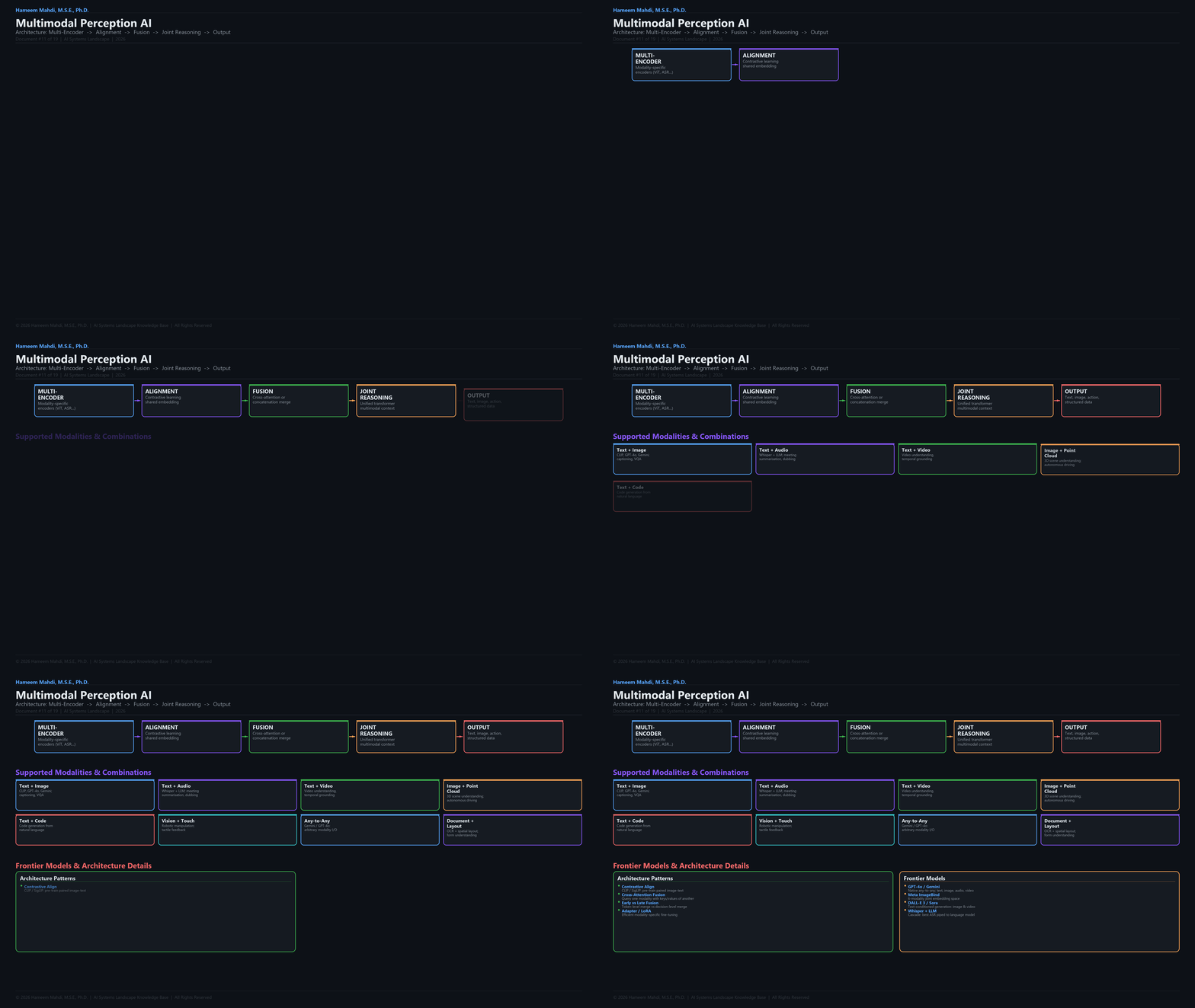
A comprehensive interactive exploration of Multimodal AI — the fusion pipeline, 8-layer stack, modality combinations, VLMs, sensor fusion, benchmarks, market data, and more.
~52 min read · Interactive ReferenceThree distinct modality streams converge through encoders into a unified fusion module, enabling cross-modal reasoning and unified output generation.
┌──────────────────────────────────────────────────────────────────────────┐
│ MULTIMODAL PERCEPTION AI — FUSION PIPELINE │
│ │
│ MODALITY A MODALITY B MODALITY C │
│ (Vision) (Language) (Audio) │
│ ────────── ────────── ────── │
│ Image/Video Text/Docs Speech/Sound │
│ │ │ │ │
│ ▼ ▼ ▼ │
│ Vision Encoder Text Encoder Audio Encoder │
│ (ViT, CNN) (Transformer) (Whisper, AST) │
│ │ │ │ │
│ ▼ ▼ ▼ │
│ Visual tokens Text tokens Audio tokens │
│ │ │ │ │
│ └─────────────────┼──────────────────┘ │
│ ▼ │
│ ┌─────────────────────┐ │
│ │ FUSION MODULE │ │
│ │ ───────────── │ │
│ │ Cross-attention │ │
│ │ Concatenation │ │
│ │ Shared embedding │ │
│ │ Gating / Routing │ │
│ └──────────┬──────────┘ │
│ ▼ │
│ Unified multimodal representation │
│ │ │
│ ▼ │
│ ┌─────────────────────┐ │
│ │ REASONING HEAD │ │
│ │ Classification │ │
│ │ Generation │ │
│ │ Decision │ │
│ └─────────────────────┘ │
└──────────────────────────────────────────────────────────────────────────┘
| Step | What Happens |
|---|---|
| Modality-Specific Encoding | Each input modality is processed by a specialised encoder — ViT for images, Transformer for text, Whisper for audio |
| Tokenisation / Embedding | Each encoder produces a sequence of tokens or embeddings representing its modality |
| Alignment | Representations from different modalities are aligned into a shared embedding space or aligned through cross-attention |
| Fusion | Aligned representations are combined — early fusion (raw features), late fusion (decision-level), or hybrid (attention-based) |
| Cross-Modal Reasoning | The fused representation is processed by reasoning layers that attend across modalities — "the image shows a cat and the text says 'the animal is sleeping'" |
| Task Head | A task-specific head produces the output — classification, captioning, VQA, generation, or decision |
| Output | The system produces its final output — grounded in multiple modalities |
| Parameter | What It Controls |
|---|---|
| Number of Modalities | How many input types the system processes (2 = bimodal, 3+ = multimodal) |
| Fusion Strategy | When and how modalities are combined — early, late, hybrid, cross-attention |
| Alignment Method | How modality representations are mapped into a shared space — contrastive learning, projection layers |
| Encoder Architecture | Which encoder is used for each modality — ViT, CNN, Transformer, Whisper, BERT |
| Cross-Attention Pattern | How modalities attend to each other — full cross-attention, bottleneck tokens, gated attention |
| Resolution / Granularity | Input resolution for each modality — image patches, audio frame rate, token granularity |
| Modality Dropout | Training technique: randomly drop modalities during training to improve robustness to missing inputs |
| Temporal Alignment | For time-series modalities (video + audio): how frames and audio segments are synchronised |
CLIP by OpenAI learned visual concepts from 400 million image-text pairs scraped from the internet.
GPT-4V can describe images, read handwriting, solve visual puzzles, and interpret charts — all in one model.
Autonomous vehicles fuse data from 8+ cameras, 5+ radars, and LiDAR — processing 1 TB/hour of sensor data.
Test your understanding — select the best answer for each question.
Q1. What does "sensor fusion" mean in multimodal AI?
Q2. What does CLIP learn to align?
Q3. What is a Vision-Language Model (VLM)?
Click any layer to expand and learn more about its role in the multimodal perception pipeline.
| Layer | What It Covers |
|---|---|
| 1. Sensor / Input Layer | Cameras, microphones, LiDAR, radar, document scanners, text inputs, depth sensors, tactile sensors |
| 2. Modality-Specific Encoders | ViT (vision), Whisper (audio), Transformer (text), PointNet (3D point clouds), spectrogram encoders |
| 3. Alignment / Projection | Projection layers, contrastive pre-training (CLIP), shared embedding spaces, temporal alignment |
| 4. Fusion Module | Early/late/hybrid fusion, cross-attention, bottleneck tokens, gated fusion, concatenation |
| 5. Cross-Modal Reasoning | Cross-attention Transformer layers, unified decoder, multimodal graph reasoning |
| 6. Task Heads | Classification, VQA, captioning, grounding, generation, detection, segmentation |
| 7. Output / Generation | Text output, bounding boxes, segmentation masks, audio synthesis, action commands |
| 8. Evaluation & Monitoring | Per-modality and cross-modal performance tracking, missing modality handling, drift detection |
11 modality combinations ranging from bimodal pairs to any-to-any architectures.
Image captioning, visual question answering (VQA), document understanding, and visual grounding — the most mature multimodal pairing.
Speech recognition, audio captioning, and spoken dialogue systems that translate acoustic signals into linguistic meaning.
Video understanding with sound, audio-visual source separation, and lip reading — correlating visual and auditory streams.
Video summarisation, multimedia retrieval, and meeting transcription combining all three primary modalities.
Robotics grasping, AR/VR spatial understanding, and indoor navigation using RGB images paired with depth information.
Autonomous vehicle 3D perception and multi-sensor fusion — the gold standard for self-driving stacks.
Document understanding, form parsing, and invoice processing combining OCR text, table structure, and visual layout.
Any combination of two modalities. Simplest fusion setup; well-studied with strong benchmarks (CLIP, BLIP, Whisper).
Combines three modalities for richer context. Common in video understanding (vision + audio + text) and AV sensor stacks.
Typical for autonomous vehicle sensor fusion combining cameras, LiDAR, radar, GPS, and IMU for robust 3D understanding.
Arbitrary combination of inputs and outputs — a single model that can process and generate any modality. GPT-4o, Gemini 2.0.
| Modality Combination | Name | Example Applications |
|---|---|---|
| Vision + Language | Vision-Language (VL) | Image captioning, VQA, document understanding, visual grounding |
| Audio + Language | Audio-Language (AL) | Speech recognition, audio captioning, spoken dialogue |
| Vision + Audio | Audio-Visual (AV) | Video understanding, audio-visual source separation, lip reading |
| Vision + Audio + Language | Video-Language-Audio (VLA) | Video summarisation, multimedia retrieval, meeting transcription |
| Vision + Depth / 3D | RGB-D / 3D Vision | Robotics grasping, AR/VR, indoor navigation |
| Vision + LiDAR + Radar | Autonomous Vehicle Fusion | 3D object detection, path planning, scene understanding |
| Text + Tabular + Image | Document Multimodal | Form understanding, invoice processing, medical report analysis |
| Text + Molecular | Biomedical Multimodal | Drug discovery, protein-text grounding |
| Category | Modalities | Example |
|---|---|---|
| Bimodal | 2 modalities | Image + text (VLM) |
| Trimodal | 3 modalities | Video + audio + text |
| Many-Modal | 4+ modalities | AV sensor fusion (camera + LiDAR + radar + GPS + IMU) |
| Any-to-Any | Arbitrary input/output modalities | GPT-4o (text, image, audio in/out); Gemini |
8 foundational multimodal architectures, from contrastive learning to autonomous-vehicle-specific fusion methods.
Contrastive learning aligning image and text embeddings in a shared space. Enables zero-shot classification and retrieval without task-specific training.
Combines raw features from all modalities at the input level. Maximises cross-modal interaction from the very first layer, but computationally expensive.
Separate unimodal models process each modality independently, then combine predictions at the decision level. Simple and modular, but limited cross-modal interaction.
One modality attends to another’s keys and values via transformer attention layers. Enables selective information exchange between modalities.
Learnable latent query tokens compress information from all modalities. Scales efficiently to many input streams (Perceiver, Flamingo).
Bird’s eye view projection creates a unified 2D grid from cameras and LiDAR. The current industry standard for autonomous vehicle 3D perception.
Multiple cameras with estimated depth, no LiDAR. Tesla’s approach: cheaper hardware but requires sophisticated vision transformers for 3D reconstruction.
LiDAR provides precise 3D structure while cameras add rich semantics and colour. The industry standard for L4+ autonomous driving (Waymo, Cruise).
| Aspect | Detail |
|---|---|
| Core Idea | Models that jointly process images and text — can understand images in context of text and generate text conditioned on images |
| Architecture | Typically: vision encoder (ViT) + projection layer + language model (Transformer) |
| Training | Pre-trained on large-scale image-text pairs (web data); fine-tuned for downstream tasks |
| Key Models | GPT-4o (OpenAI), Gemini (Google), Claude vision (Anthropic), LLaVA, InternVL, Qwen-VL |
| Capabilities | Image captioning, visual question answering (VQA), document understanding, image-grounded conversation, visual reasoning |
| Aspect | Detail |
|---|---|
| Core Idea | Train paired encoders (image + text) to map matching image-text pairs close together and non-matching pairs far apart in a shared embedding space |
| CLIP | Contrastive Language-Image Pre-training (OpenAI, 2021) — trained on 400M image-text pairs from the web |
| How It Works | Image encoder (ViT) and text encoder (Transformer) produce embeddings; contrastive loss maximises cosine similarity for matching pairs |
| Capabilities | Zero-shot classification (describe a class in text; match to images); image-text retrieval; semantic image search |
| Successors | SigLIP (Google), EVA-CLIP, OpenCLIP, MetaCLIP |
| Significance | CLIP created the foundational alignment between vision and language that powers modern VLMs |
| Aspect | Detail |
|---|---|
| Core Idea | Combine raw or lightly processed inputs from all modalities before any significant processing — a single model processes the concatenated input |
| How It Works | Tokenise all modalities → concatenate token sequences → process through a shared Transformer |
| Example | GPT-4o processes interleaved image tokens and text tokens in the same context window |
| Strengths | Maximum cross-modal interaction; the model can learn arbitrary relationships between modalities |
| Limitations | Computationally expensive (long sequences); requires large-scale multi-modal training data |
| Aspect | Detail |
|---|---|
| Core Idea | Process each modality independently with separate models; combine their outputs (predictions, features) at the decision level |
| How It Works | Independent modality-specific models → each produces an output → outputs are combined by averaging, voting, or a learned combiner |
| Example | Separate image classifier and text classifier; combined predictions for multimodal sentiment |
| Strengths | Simple; modular; can use pre-trained unimodal models; handles missing modalities gracefully |
| Limitations | Limited cross-modal interaction; cannot learn fine-grained cross-modal relationships |
| Aspect | Detail |
|---|---|
| Core Idea | One modality attends to another through cross-attention layers — text tokens attend to visual tokens and vice versa |
| How It Works | Queries from modality A attend to keys/values from modality B → produces modality-A representations enriched with modality-B information |
| Example | Flamingo (DeepMind) — language model cross-attends to visual features; Q-Former in BLIP-2 |
| Strengths | Rich cross-modal interaction; can handle variable-length inputs from each modality |
| Limitations | Quadratic cost in attention; requires careful architectural design |
| Aspect | Detail |
|---|---|
| Core Idea | Use a small set of learnable "bottleneck tokens" (latent queries) that attend to all modalities — compressing cross-modal information into a fixed-size representation |
| Examples | Perceiver (DeepMind); Q-Former (in BLIP-2); Perceiver IO; DETR (for object detection) |
| Strengths | Scales to many modalities and long inputs; fixed compute regardless of input length |
| Limitations | Information bottleneck may lose fine-grained details |
| Aspect | Detail |
|---|---|
| Core Idea | Combine data from multiple physical sensors — cameras, LiDAR, radar, ultrasonics, IMU, GPS — into a unified perception model |
| Approaches | BEV (Bird's Eye View) fusion; point cloud + image fusion; temporal fusion across frames |
| Key Challenge | Sensors operate at different spatial resolutions, temporal rates, and coordinate systems — calibration and alignment are critical |
| Example | Tesla Vision (cameras), Waymo (cameras + LiDAR + radar), NVIDIA DriveNet |
Leading multimodal models and the developer tools powering the ecosystem.
| Model | Vendor | Description |
|---|---|---|
| GPT-4o | OpenAI | Native multimodal (text, image, audio); strongest commercial multimodal model |
| Gemini 2.0 | 1M+ context window; strong on video and document understanding | |
| Claude 3.5 / 4 | Anthropic | Vision + text; excellent document and chart understanding |
| Llama 4 | Meta | Open-weight multimodal vision + text model family |
| Qwen-VL 2 | Alibaba | Open-weight; multilingual VLM; strong document capabilities |
| InternVL 2.5 | Shanghai AI Lab | Open-source; competitive performance with proprietary models |
| Tool | Description |
|---|---|
| Hugging Face Transformers | Unified API for VLMs, audio models, and multimodal pipelines |
| LLaVA | Visual instruction tuning framework for building vision-language models |
| MMDetection3D | 3D object detection toolbox for autonomous vehicle research |
| NVIDIA DriveWorks | Autonomous vehicle sensor fusion SDK with hardware acceleration |
| Apollo (Baidu) | Open-source autonomous driving platform with multi-sensor fusion |
| ROS 2 | Standard middleware framework for robotic sensor fusion and perception |
| Model / API | Provider | Deployment | Highlights |
|---|---|---|---|
| GPT-4o / GPT-4.5 | OpenAI | Cloud (Azure-hosted; available via Azure OpenAI) | Native multimodal (text, image, audio); strongest commercial multimodal model |
| Gemini 2.0 | Google DeepMind | Cloud (GCP) | Native multimodal; long context (1M+ tokens); strong video and document understanding |
| Claude 3.5 / Claude 4 | Anthropic | Cloud (AWS, GCP) | Vision + text; strong on document understanding and analysis tasks |
| Llama 4 | Meta (open-weight) | Open-Source (any OS; Python 3.10+; NVIDIA GPU — 80 GB+ VRAM for large variants; CUDA 12+) | Multimodal Llama variant; open-weight; vision + text |
| Qwen-VL 2 | Alibaba (open-weight) | Open-Source (any OS; Python 3.9+; NVIDIA GPU; CUDA 11.8+) | Multilingual VLM; strong document understanding |
| InternVL 2.5 | Shanghai AI Lab (open-source) | Open-Source (Linux; Python 3.9+; NVIDIA GPU — A100 recommended; CUDA 11.8+) | Competitive open-source VLM |
| LLaVA-OneVision | Open-source | Open-Source (Linux; Python 3.9+; NVIDIA GPU; CUDA 11.8+) | Visual instruction tuning framework; strong research baseline |
| Whisper | OpenAI (open-source) | Open-Source (any OS; Python 3.8+; CPU or NVIDIA GPU; CUDA 11.8+) | State-of-the-art speech recognition; multilingual; widely used as audio encoder |
| Framework | Provider | Deployment | Highlights |
|---|---|---|---|
| Hugging Face Transformers | Hugging Face (open-source) | Open-Source (any OS; Python 3.9+; CPU or NVIDIA GPU; CUDA 11.8+) | Unified API for VLMs, audio models, multimodal pipelines; largest model hub |
| LLaVA | Open-source | Open-Source (Linux; Python 3.9+; NVIDIA GPU — A100 for training; smaller GPU for inference) | Framework for training and deploying VLMs with visual instruction tuning |
| MMDetection3D | OpenMMLab (open-source) | Open-Source (Linux; Python 3.8+; PyTorch; NVIDIA GPU; CUDA 11.8+) | 3D object detection for AV; supports camera, LiDAR, and fusion models |
| MMAction2 | OpenMMLab (open-source) | Open-Source (Linux; Python 3.8+; PyTorch; NVIDIA GPU; CUDA 11.8+) | Video understanding framework; action recognition, temporal localisation |
| LAVIS | Salesforce (open-source) | Open-Source (any OS; Python 3.8+; PyTorch; NVIDIA GPU recommended) | Library for vision-language models; BLIP-2, InstructBLIP |
| NeMo Multimodal | NVIDIA (open-source) | Open-Source (Linux; Python 3.10+; NVIDIA GPU — A100/H100; CUDA 12+; multi-GPU) | Framework for training and deploying multimodal models at scale |
| vLLM | Open-source | Open-Source (Linux; Python 3.8+; NVIDIA GPU; CUDA 11.8+) | High-throughput inference engine; increasingly supports multimodal models |
| Platform | Provider | Deployment | Highlights |
|---|---|---|---|
| NVIDIA DriveWorks | NVIDIA | On-Prem / Edge (NVIDIA DRIVE Orin/Thor SoC; Linux; NVIDIA GPU) | AV sensor fusion SDK; camera, LiDAR, radar processing |
| Apollo (Baidu) | Baidu (open-source) | Open-Source (Linux; x86 + NVIDIA GPU; Docker; vehicle-mounted compute unit) | Open-source autonomous driving platform; multi-sensor fusion |
| autoware | Autoware Foundation (open-source) | Open-Source (Linux Ubuntu; x86 + NVIDIA GPU; ROS 2; vehicle-mounted compute) | Open-source self-driving software stack; ROS-based sensor fusion |
| ROS 2 | Open Robotics (open-source) | Open-Source (Linux Ubuntu 22.04+; x86 or ARM; CPU-based) | Robot Operating System; standard for robotic sensor fusion and perception |
| NVIDIA Isaac | NVIDIA | On-Prem (Linux; NVIDIA RTX GPU) / Cloud (AWS EC2 G5/P4d; GCP A2; NVIDIA Omniverse Cloud) | Robotics AI platform; multi-sensor perception, simulation |
Key application domains where multimodal perception AI delivers critical value.
Modalities: Camera + LiDAR + Radar
Key players: Waymo, Cruise, Mobileye
Fusing visual semantics with LiDAR depth and radar velocity to detect and classify objects in 3D space at long range. Foundation of L4 autonomous driving.
Modalities: Camera (primary), HD maps
Key players: Tesla Vision, Mobileye, TuSimple
Detecting lane boundaries, drivable areas, and road topology using multi-camera vision systems with BEV projection.
Modalities: Camera + LiDAR
Key players: Tesla, NVIDIA, academic labs
Predicting 3D voxel occupancy of the scene — denser and more general than bounding boxes. Emerging as the next-gen representation for AV perception.
Modalities: Camera + LiDAR + HD map
Key players: Waymo MotionNet, Argoverse, nuPlan
Predicting future trajectories of agents (vehicles, pedestrians, cyclists) using past observations from multiple sensor modalities.
Modalities: Medical image + clinical notes
Key players: Google Health, Microsoft Nuance, Rad-DINO
Combining medical imaging (X-ray, CT, MRI) with clinical text for integrated diagnosis, report generation, and triage prioritisation.
Modalities: Histopathology slides + gene expression
Key players: PathAI, Paige, research hospitals
Fusing whole-slide histopathology images with genomic and transcriptomic data for cancer prognosis, subtyping, and treatment response prediction.
| Use Case | Description | Key Examples |
|---|---|---|
| 3D Object Detection | Detect and classify vehicles, pedestrians, cyclists from camera + LiDAR + radar | Waymo, Cruise, Mobileye |
| Lane & Road Understanding | Detect lane boundaries, drivable area, road signs from camera | Tesla Vision, comma.ai |
| Occupancy Prediction | Predict which 3D voxels are occupied — a denser representation than bounding boxes | Tesla Occupancy Network |
| Motion Forecasting | Predict future trajectories of other agents using perception history | Waymo MotionNet, UniSim |
| End-to-End Driving | Single model from raw sensor input to steering/throttle output | NVIDIA DRIVE Thor, Tesla FSD |
| Use Case | Description | Key Examples |
|---|---|---|
| Radiology + Report | AI reads both the medical image and the clinical report for integrated diagnosis | CheXpert multimodal, RadBERT + ViT |
| Pathology + Genomics | Combine histopathology images with genomic data for cancer prognosis | PORPOISE (Pathology-Omic Research Predictive Outcome Integrated Survival Estimation), Paige AI |
| Surgical AI | Fuse endoscope video + instrument tracking + patient data for surgical guidance | Intuitive Surgical research |
| Multimodal Clinical Trials | Combine imaging, lab results, EHR data for trial endpoint prediction | Pharma multimodal models |
| Ambient Clinical Intelligence | Combine audio (doctor-patient conversation) + EHR to auto-generate clinical notes | Nuance DAX Copilot |
| Use Case | Description | Key Examples |
|---|---|---|
| Visual Search | Upload a photo → find matching products in catalogue | Google Lens, Pinterest Lens, Amazon StyleSnap |
| Product Understanding | Combine product images, titles, descriptions, reviews for rich cataloguing | Amazon, Alibaba |
| Try-On / Virtual Fitting | Image + body measurement for virtual clothing try-on | Zeekit (Walmart), Google virtual try-on |
| Use Case | Description | Key Examples |
|---|---|---|
| Video Understanding | Combine visual, audio, and text (subtitles) to understand and search video content | YouTube video understanding, Netflix tagging |
| Content Moderation | Analyse images, text, and audio together for policy violation detection | Meta, YouTube — multimodal content safety |
| Accessibility | Image description for visually impaired users; audio description for hearing impaired | Be My AI (Be My Eyes + GPT-4o), auto-captioning |
| Use Case | Description | Key Examples |
|---|---|---|
| Video Analytics | Combine camera feeds with audio, access logs, and sensor alerts for security monitoring | Smart city surveillance, airport security |
| Person Re-Identification | Match persons across multiple cameras using appearance, gait, and context | Multi-camera tracking systems |
| Satellite + Ground Data | Combine satellite imagery with ground-truth reports and weather data | Defense and intelligence; disaster response |
| Use Case | Description | Key Examples |
|---|---|---|
| Robotic Grasping | Combine camera (RGB) + depth sensor for accurate object manipulation | PR2, Stretch robot, NVIDIA Isaac |
| Language-Guided Manipulation | Robot follows natural language instructions grounded in visual perception | RT-2 (Google), SayCan, VoxPoser |
| Haptic + Visual Feedback | Combine tactile and visual sensing for delicate manipulation | GelSight + camera fusion for dexterous manipulation |
State-of-the-art accuracy on leading multimodal and AV perception benchmarks.
| Benchmark | What It Tests |
|---|---|
| VQAv2 | Visual question answering — open-ended questions about images |
| GQA | Compositional visual question answering with structured reasoning |
| TextVQA / OCR-VQA | Questions requiring reading text within images |
| DocVQA | Document visual question answering — forms, invoices, reports |
| ChartQA | Questions about chart and graph images |
| MMMU | Massive Multi-discipline Multimodal Understanding — expert-level questions with images across 30 disciplines |
| MMBench | Comprehensive multimodal model evaluation with fine-grained ability assessment |
| COCO Captions | Image captioning quality (CIDEr, BLEU, METEOR, SPICE) |
| RefCOCO / RefCOCO+ | Referring expression comprehension — grounding phrases to image regions |
| Flickr30k | Image-text retrieval benchmark |
| RealWorldQA | Real-world visual understanding and reasoning |
| Benchmark | What It Tests |
|---|---|
| nuScenes | 3D object detection and tracking from camera, LiDAR, radar; primary AV benchmark |
| KITTI | Outdoor 3D object detection, tracking, depth estimation; pioneering AV benchmark |
| Waymo Open Dataset | Large-scale AV perception: 3D detection, tracking, prediction |
| Argoverse 2 | AV perception with HD maps; motion forecasting |
| SUN RGB-D | Indoor scene understanding from RGB-D (colour + depth) images |
| ScanNet | 3D indoor scene understanding from RGB-D video |
| Metric | What It Measures |
|---|---|
| Accuracy / F1 | Standard classification metrics for VQA, grounding tasks |
| CIDEr / BLEU / METEOR | Captioning quality metrics comparing generated captions to references |
| mAP (mean Average Precision) | Object detection accuracy — standard for AV perception |
| NDS (nuScenes Detection Score) | Composite score including mAP, translation, scale, orientation, velocity, attribute errors |
| Cross-Modal Retrieval Recall | Recall@K for image-text and text-image retrieval |
| Grounding Accuracy | IoU (Intersection over Union) between predicted and ground-truth regions |
| Fusion Gain | Performance improvement from multimodal fusion vs. best single-modality baseline |
| Missing Modality Robustness | Performance when one or more modalities are absent or degraded |
Market sizes, revenue segments, and projected growth for multimodal AI technologies.
| Metric | Value | Source / Notes |
|---|---|---|
| Multimodal AI Market (2024) | ~$5.8 billion | Fortune Business Insights; includes VLMs, sensor fusion, multimodal platforms |
| Projected Multimodal AI Market (2030) | ~$98 billion | Driven by AV, healthcare, and multimodal LLMs |
| VLM API Revenue (2024) | >$2 billion | GPT-4 Vision, Gemini, Claude Vision API revenue |
| AV Sensor Fusion Market (2024) | ~$7.5 billion | Camera, LiDAR, radar fusion for ADAS and AV |
| Organisations Using Multimodal AI (2024) | ~28% of AI-deploying organisations | Gartner; primarily in tech, automotive, healthcare |
| Trend | Description |
|---|---|
| Native Multimodal Models | The shift from "pipeline of unimodal models" to "single natively multimodal model" is accelerating |
| Vision + Language Dominant | Vision-language is the most mature and widely deployed multimodal combination |
| Camera-Only AV Growing | Tesla's camera-only approach is gaining validation; LiDAR still dominant for Level 4+ |
| Multimodal Agents | AI agents that see, hear, and interact with computer interfaces (screen + mouse + keyboard) |
| Video Understanding Emerging | Long video understanding is a major active frontier (Gemini 1M+ context, video LLMs) |
| Multimodal Search | Visual search (Google Lens, CLIP-based search) is becoming mainstream |
| Any-to-Any Models | The trend toward models that accept and produce any modality (GPT-4o, Gemini 2.0) |
| Edge Multimodal | Deploying multimodal models on edge devices (phones, robots, vehicles) with reduced compute |
Key technical and operational risks in multimodal perception AI systems.
Unequal quality, quantity, or resolution across modalities. A high-quality image paired with noisy audio degrades overall performance and creates training instability.
One modality (typically vision) overshadows others during training, causing the model to ignore weaker but informative signals from audio or text.
Misaligned timestamps, spatial misregistration, or wrong pairings between modalities. Critical in AV where nanosecond sync errors can shift objects metres.
Models degrade unpredictably when a modality is absent at inference time (e.g., camera failure on an AV). Robust fusion must handle partial inputs gracefully.
Multimodal models are significantly larger than unimodal counterparts. Multiple encoders, fusion layers, and cross-attention scale memory and compute requirements.
VLMs “see” objects not actually present in the image, fabricating visual details based on language priors. A critical reliability issue for safety applications.
| Limitation | Description |
|---|---|
| Data Imbalance Across Modalities | Training data often has unequal quality and quantity across modalities — e.g., abundant text but limited paired image-text |
| Modality Dominance | One modality (often language) can dominate during training, with the model learning to rely on it and ignore others |
| Alignment Errors | Misalignment between modalities (wrong timestamp sync, wrong image-text pairing) degrades performance |
| Missing Modality Fragility | Many multimodal systems degrade significantly when a modality is absent or corrupted |
| Computational Cost | Multimodal models are significantly larger and more expensive to train and run than unimodal models |
| Hallucination from Cross-Modal Errors | VLMs can "hallucinate" objects or descriptions not present in the image, often importing bias from the text modality |
| Evaluation Complexity | Evaluating multimodal systems is harder — performance must be assessed per-modality, cross-modality, and end-to-end |
| Privacy Across Modalities | Multiple modalities can combine to reveal more about individuals than any single modality alone |
| Failure | Description |
|---|---|
| Object Hallucination | VLMs confidently describe objects not present in the image |
| Spatial Reasoning Failure | VLMs struggle with precise spatial relationships ("left of", "above", "between") |
| Counting Errors | VLMs frequently miscount objects in images |
| Temporal Hallucination | Video models confuse the temporal order of events |
| Sensor Miscalibration | In AV systems, miscalibrated sensors produce incorrect fusion — e.g., LiDAR points don't align with camera pixels |
| Modality Shortcut | Model learns to rely on one modality (e.g., text) and ignores the other (e.g., image) — performs well on benchmarks but fails in practice |
| Criterion | Why Multimodal Excels |
|---|---|
| Complementary Information | When different modalities carry complementary signals (image shows anatomy; report describes findings) |
| Disambiguation | When a single modality is ambiguous but another modality resolves it (lip reading helps speech recognition in noise) |
| Robustness | When one modality may fail (camera in darkness; LiDAR in rain) — redundancy from multiple sensors |
| Rich Understanding | When the task fundamentally requires understanding across modalities (video Q&A, document understanding) |
| Human-Like Interaction | When the system needs to communicate with humans via multiple channels (voice + screen + gestures) |
Explore how this system type connects to others in the AI landscape:
Generative AI Conversational AI Physical / Embodied AI Autonomous AI Scientific / Simulation AIKey terms in multimodal perception AI.
| Term | Definition |
|---|---|
| Alignment | Mapping representations from different modalities into a shared embedding space so they can be compared and combined |
| Any-to-Any Model | A model that can accept any combination of input modalities and produce any combination of output modalities |
| BEV (Bird's Eye View) | A top-down representation of a scene; common in autonomous driving for fusing sensor data into a unified spatial format |
| Bottleneck Tokens | A small set of learnable vectors that compress information from all modalities into a fixed-size representation |
| CLIP | Contrastive Language-Image Pre-training; an OpenAI model that aligns image and text embeddings via contrastive learning |
| Contrastive Learning | A training approach that learns to map matching pairs (e.g., image-text) close together and non-matching pairs far apart |
| Cross-Attention | An attention mechanism where one modality's queries attend to another modality's keys and values |
| Cross-Modal | Spanning or relating to multiple modalities (e.g., cross-modal retrieval = finding an image from a text query) |
| Early Fusion | Combining raw or lightly processed features from all modalities before any significant processing |
| Grounding | Connecting language to visual or physical reality — e.g., linking the word "cup" to a specific object in an image |
| Hallucination (VLM) | When a vision-language model describes objects or details not present in the input image |
| Late Fusion | Processing each modality independently and combining at the decision level |
| LiDAR | Light Detection and Ranging — a sensor that measures distances by emitting laser pulses and timing their return |
| Modality | A type of sensory input or data — vision, language, audio, depth, tactile, etc. |
| Modality Dominance | When a model over-relies on one modality during training, ignoring useful information from others |
| Modality Dropout | A training technique that randomly removes modalities during training to improve robustness |
| MMMU | Massive Multi-discipline Multimodal Understanding — a benchmark for expert-level multimodal reasoning |
| nuScenes | A major autonomous driving dataset with camera, LiDAR, radar, and map data; a primary sensor fusion benchmark |
| Occupancy Network | A 3D representation that predicts whether each voxel in a 3D grid is occupied — denser than bounding boxes |
| Perceiver | A Transformer variant (DeepMind) using cross-attention with learnable latent arrays to handle arbitrary input modalities |
| Point Cloud | A set of 3D points (x, y, z) produced by LiDAR or depth sensors representing the surfaces of objects |
| Q-Former | A learned module (from BLIP-2) that uses learnable queries to extract visual features relevant to language |
| Radar | Radio Detection and Ranging — a sensor using radio waves to detect objects, measure distance, and estimate velocity |
| Sensor Fusion | Combining data from multiple physical sensors into a unified perception — standard in autonomous vehicles and robotics |
| Temporal Alignment | Synchronising data streams from different sensors or modalities that operate at different sampling rates |
| ViT (Vision Transformer) | A Transformer architecture that processes images by dividing them into patches and treating each patch as a token |
| Visual Grounding | Localising a region in an image corresponding to a natural language description |
| VLM (Vision-Language Model) | A model that jointly processes visual and textual input — the dominant form of commercial multimodal AI |
| VQA (Visual Question Answering) | A task where the model answers a natural language question about an image |
| Whisper | An OpenAI model for automatic speech recognition; widely used as an audio encoder in multimodal systems |
Animation infographics for Multimodal Perception AI — overview and full technology stack.
Animation overview · Multimodal Perception AI · 2026
Animation tech stack · Hardware → Compute → Data → Frameworks → Orchestration → Serving → Application · 2026
Detailed reference content for regulation.
| Regulation | Multimodal Relevance |
|---|---|
| EU AI Act | High-risk AI (autonomous vehicles, medical imaging) must demonstrate robustness — multimodal fusion introduces specific failure modes that must be addressed |
| GDPR | Combining modalities (facial images + voice + location) can increase re-identification risk; data minimisation applies per modality |
| Medical Device Regulations (FDA, EU MDR) | Multimodal clinical AI must validate performance across modalities and document fusion behaviour |
| AV Regulations (UNECE, NHTSA) | Autonomous vehicle perception systems must demonstrate sensor fusion reliability and graceful degradation |
| Accessibility Standards (WCAG, ADA) | Multimodal systems should provide alternative modalities for users with disabilities |
| Biometric Regulations | Combining facial, voice, and gait biometrics faces strict regulation in many jurisdictions (EU AI Act, BIPA) |
| Practice | Description |
|---|---|
| Per-Modality Performance Reporting | Report model performance broken down by each input modality — not just aggregate |
| Missing Modality Testing | Test system behaviour when each modality is absent, degraded, or adversarial |
| Sensor Diversity Documentation | Document which sensors/modalities are used, their failure modes, and redundancy strategy |
| Data Pairing Audits | Verify that multimodal training data is correctly paired (image matches text, audio matches video) |
| Cross-Modal Bias Assessment | Assess whether biases in one modality (e.g., gender bias in language) transfer to cross-modal predictions |
| Graceful Degradation | Design systems to function adequately when modalities are missing — avoid catastrophic failure |
Detailed reference content for deep dives.
| Generation | Description | Examples |
|---|---|---|
| Feature Concatenation (2015–2018) | CNN image features + LSTM/RNN text; late or simple fusion | Show-and-Tell, VQA v1 |
| Pre-trained Vision-Language (2019–2021) | Joint pre-training on image-text pairs with Transformer | ViLBERT, LXMERT, UNITER, Oscar |
| Contrastive Alignment (2021–2022) | Separate encoders aligned via contrastive loss | CLIP, ALIGN, Florence |
| Decoder-Based VLMs (2022–2023) | Language model backbone + visual encoder + projection | Flamingo, BLIP-2, LLaVA, InstructBLIP |
| Native Multimodal LLMs (2023–2026) | Unified architecture processing text and image tokens natively | GPT-4o, Gemini, Claude Vision, Qwen-VL2, InternVL-2.5 |
| Model | Provider | Capabilities |
|---|---|---|
| GPT-4o | OpenAI | Native multimodal: text, image, audio input and output; leading benchmark performance; real-time interaction |
| Gemini 2.0 | Google DeepMind | Native multimodal with 1M+ token context; strong on long-video, multi-image, document understanding |
| Claude 3.5 / Claude 4 | Anthropic | Vision + text; strong document and chart understanding; careful safety design |
| LLaVA-NeXT / LLaVA-OneVision | Open-source | Visual instruction tuning; strong open-source VLM baseline |
| InternVL 2.5 | Shanghai AI Lab (open-source) | Strong open-source VLM; competitive with proprietary models |
| Qwen-VL 2 | Alibaba (open-source) | Multilingual VLM with strong document and chart understanding |
| Pixtral | Mistral (open-source) | Natively multimodal at various sizes |
| PaLI-3 / PaLI-X | Vision-language model optimised for fine-grained understanding |
| Task | Description |
|---|---|
| Image Captioning | Generate a natural language description of an image |
| Visual Question Answering (VQA) | Answer a natural language question about an image |
| Visual Grounding | Locate a region in an image corresponding to a natural language description |
| Referring Expression Comprehension | Given "the red cup on the left," identify the correct bounding box |
| Document Understanding | Parse and understand structured documents (invoices, forms, charts, PDFs) from images |
| OCR + Understanding | Extract and reason about text within images |
| Image-Text Retrieval | Find the most relevant image for a text query (or vice versa) |
| Visual Reasoning | Answer questions requiring spatial, logical, or quantitative reasoning about visual content |
| Chart / Graph Understanding | Interpret data visualisations and answer questions about them |
| Sensor | What It Captures | Strengths | Weaknesses |
|---|---|---|---|
| Camera (RGB) | Dense visual information, colour, texture, semantics (road signs, lanes) | Rich detail; cheap; proven | Poor in low light, rain, fog; no native depth |
| LiDAR | 3D point cloud; precise distance measurements | Accurate depth and shape; works in darkness | Expensive; sparse; degraded in heavy rain/snow |
| Radar | Object distance, velocity (Doppler); millimetre-wave | All-weather; direct velocity measurement | Low resolution; poor at classification |
| Ultrasonics | Short-range distance | Very cheap; good for parking | Very short range (< 5m) |
| IMU / GPS | Vehicle position, acceleration, orientation | Global positioning; motion sensing | GPS has limited precision; IMU drifts |
| Infrared / Thermal | Heat signatures | Detects pedestrians in darkness | Low resolution; expensive |
| Approach | Description |
|---|---|
| Camera-Only (Tesla Vision) | Uses multiple cameras only; neural network estimates depth from monocular/stereo cues; lower hardware cost |
| LiDAR + Camera (Waymo, Cruise) | LiDAR provides 3D structure; cameras add semantic detail; fusion in BEV (Bird's Eye View) space |
| Radar + Camera | Radar provides velocity and all-weather detection; camera adds classification; common in ADAS |
| Full Fusion | All sensors combined; maximum redundancy and robustness; highest cost and complexity |
| Aspect | Detail |
|---|---|
| What | Transform all sensor data into a unified top-down (bird's eye view) representation — a 2D grid of the vehicle's surroundings |
| Why | All sensor data in one coordinate system; planning and prediction operate naturally in BEV |
| How | Camera features are "lifted" from image space to 3D using learned depth estimation or geometry; LiDAR points are projected; all are rasterised into BEV grid |
| Key Models | BEVFormer (Li et al., 2022), BEVDet, BEVFusion, LSS (Lift-Splat-Shoot) |
| Industry Adoption | Tesla Occupancy Network (camera-only BEV); Waymo (multi-sensor BEV); most AV companies moving to BEV-based architectures |
| Modality Combination | Application |
|---|---|
| Medical Image + Clinical Notes | Radiologist AI that reads both the scan and the patient history |
| Pathology Image + Genomics | Cancer prognosis combining histopathology slides with gene expression data |
| ECG + EHR + Lab Results | Cardiac risk prediction combining waveform data with structured clinical data |
| Retinal Image + Metadata | Diabetic retinopathy screening with patient demographics |
| Multi-Stain Histopathology | Combining H&E and IHC stains for tumour characterisation |
| Era | Approach | Example |
|---|---|---|
| 2020–2022 | Separate unimodal models glued together (e.g., OCR → NLP pipeline) | Tesseract → BERT pipeline |
| 2022–2023 | Frozen vision encoder + trainable adapter + frozen LLM | BLIP-2, Flamingo |
| 2023–2024 | Vision encoder co-trained with LLM; unified token space | LLaVA-1.5, Qwen-VL, InternVL |
| 2024–2026 | Natively multimodal: text, image, audio, video as first-class token types | GPT-4o, Gemini 2.0, native multimodal architectures |
| Aspect | Detail |
|---|---|
| Definition | Models that can accept any combination of input modalities and produce any combination of output modalities |
| Input | Text, image, audio, video, code, structured data — in any combination |
| Output | Text, image, audio, video, code — generated natively |
| Example | GPT-4o: text/image/audio in → text/image/audio out; Gemini: text/image/video/audio in → text/image/audio out |
| Architecture | Common approach: modality-specific tokenisers → shared Transformer → modality-specific decoders |
| Significance | Moves AI from specialised single-modality tools to general-purpose multimodal interfaces |
| Strategy | Description |
|---|---|
| Visual Tokens via ViT | Divide image into patches → linear projection → visual tokens (same dimension as text tokens) |
| Visual Tokens via VQ-VAE | Encode image into discrete codebook tokens — can be generated autoregressively like text |
| Audio Tokens (Encodec, SoundStream) | Neural audio codec compresses audio into discrete tokens |
| Video Tokens | Sample keyframes → ViT per frame; or 3D patch tokenisation (Video ViT); temporal compression |
| Interleaved Sequences | All modalities are tokenised and interleaved in a single sequence:<text> <image> <text> <audio> |
Detailed reference content for overview.
Multimodal Perception AI processes multiple types of sensory input — text, images, video, audio, speech, depth, LiDAR, radar, tactile, thermal, and more — and combines them to understand and reason about the world. Humans are inherently multimodal: we see, hear, feel, read, and synthesise all these signals into a unified understanding. Multimodal AI aims to bring this capability to machines.
The core insight is that different modalities carry complementary information. A chest X-ray shows anatomical structures; the radiology report describes findings in language; the patient's vital signs add temporal physiological context. No single modality tells the complete story. Multimodal AI fuses them.
This field has been transformed by the rise of large multimodal models: GPT-4o, Gemini, Claude (vision), LLaVA, and similar systems that natively process text and images (and increasingly audio, video, and other modalities) in a unified architecture. These models move beyond the traditional "one model per modality" paradigm to "one model for all modalities."
| Dimension | Detail |
|---|---|
| Core Capability | Processes, fuses, and reasons across multiple data modalities for richer understanding |
| How It Works | Modality-specific encoders, cross-modal attention, early/late/hybrid fusion, unified embedding spaces |
| What It Produces | Cross-modal understanding, grounded predictions, multimodal generation, sensor-fused perception |
| Key Differentiator | Combines complementary signals from different modalities — exceeding what any single modality can achieve alone |
| AI Type | What It Does | Example |
|---|---|---|
| Multimodal Perception AI | Fuses vision, language, audio, and other modalities | GPT-4o processing image + text; AV sensor fusion |
| Agentic AI | Pursues goals autonomously with tools, memory, and planning | Research agent, coding agent |
| Analytical AI | Extracts insights from data | BI dashboard, anomaly detection |
| Autonomous AI (Non-Agentic) | Operates independently within fixed boundaries without human input | Autopilot, auto-scaling, algorithmic trading |
| Bayesian / Probabilistic AI | Reasons under uncertainty using probability distributions | Clinical trial analysis, A/B testing, risk modelling |
| Cognitive / Neuro-Symbolic AI | Combines neural learning with symbolic reasoning | LLM + knowledge graph, physics-informed neural net |
| Conversational AI | Manages multi-turn dialogue | Text-only or voice-only chatbot |
| Evolutionary / Genetic AI | Optimises solutions through population-based search inspired by natural selection | Neural architecture search, logistics scheduling |
| Explainable AI (XAI) | Makes AI decisions understandable to humans | SHAP explanations, LIME, Grad-CAM |
| Generative AI | Creates new content from learned patterns | Text, image, video generation |
| Optimisation / Operations Research AI | Finds optimal solutions to constrained mathematical problems | Vehicle routing, supply chain planning, scheduling |
| Physical / Embodied AI | Acts in the physical world with sensors and actuators | Robot with cameras and force sensors |
| Predictive / Discriminative AI | Classifies or forecasts from data | Single-modality classification |
| Privacy-Preserving AI | Trains and runs AI without exposing raw data | Federated hospital models, differential privacy |
| Reactive AI | Responds to current input with no memory or learning | Thermostat, ABS braking system |
| Recommendation / Retrieval AI | Surfaces relevant items from large catalogues based on user signals | Netflix suggestions, Google Search, Spotify playlists |
| Reinforcement Learning AI | Learns optimal behaviour from reward signals via trial and error | AlphaGo, robotic locomotion, RLHF |
| Scientific / Simulation AI | Solves scientific problems and models physical systems | AlphaFold, climate simulation, molecular dynamics |
| Symbolic / Rule-Based AI | Reasons over explicit rules and knowledge to derive conclusions | Medical expert system, legal reasoning engine |
Key Distinction: Multimodal vs. Unimodal. Unimodal AI processes a single type of input (text-only NLP, image-only vision). Multimodal AI processes multiple types simultaneously and reasons across them.
Key Distinction: Perception vs. Generation. Multimodal perception fuses inputs from multiple modalities to understand. Multimodal generation (covered primarily in Document #10 — Generative AI) produces outputs in multiple modalities. Many modern models do both.
Key Distinction: Multimodal vs. Multi-Input. Processing multiple inputs of the same modality (e.g., multiple images) is not multimodal — it's multi-input. Multimodal specifically means combining different types of data (image + text, audio + video).