AI Systems Landscape

Symbolic / Rule-Based AI — Interactive Architecture Chart

A comprehensive interactive exploration of Symbolic AI — the knowledge-reasoning pipeline, 8-layer stack, production rules, knowledge graphs, theorem provers, benchmarks, market data, and more.

~40 min read · Interactive Reference

Hameem M Mahdi, B.S.C.S., M.S.E., Ph.D.

📄 Forthcoming Paper

Knowledge-Reasoning Pipeline

Five-stage flow from domain formalisation to actionable output.

1

Knowledge Encoding

Formalise domain expertise into rules, ontologies & logical statements

2

Knowledge Base

Structured storage of facts, rules & relationships

3

Inference Engine

Apply reasoning — forward/backward chaining, resolution, unification

4

Explanation Generation

Produce inference traces & human-readable justifications

5

Decision / Action Output

Deliver final decision, recommendation or triggered action

Did You Know?

1

MYCIN (1976) diagnosed bacterial infections with 69% accuracy — outperforming most physicians at the time.

2

Prolog, a key symbolic AI language, was chosen as the core of Japan's Fifth Generation Computer Project in 1982.

3

Expert systems generated over $1 billion in annual revenue by the late 1980s before the 'AI Winter'.

Knowledge Check

Test your understanding — select the best answer for each question.

Q1. What reasoning method do expert systems primarily use?

Q2. What is an ontology in the context of symbolic AI?

Q3. Which language is most associated with symbolic AI programming?

8-Layer Stack

Layered architecture of a complete symbolic AI system — from domain expertise to human interface.

Explanation UI · Query interface · Natural-language translation layer. Enables non-technical users to interact with, query, and understand system outputs via intuitive interfaces and generated explanations.
Inference traces · Why / why-not reasoning · Compliance logs. Provides full audit trails showing exactly which rules fired, which facts were used, and why alternative conclusions were rejected.
Forward & backward chaining · Resolution · Unification · Constraint propagation. The computational core that derives new knowledge from existing facts and rules using formal reasoning algorithms.
Rules · Frames · Ontologies · Semantic networks · Description logics. Defines the formal languages and structures used to encode domain knowledge in machine-processable form.
Elicitation from experts · Automated extraction · Ontology learning. Covers methods and tools for capturing, extracting, and formalising knowledge from human experts and unstructured sources.
Consistency checking · Completeness analysis · Conflict resolution. Ensures the knowledge base is logically sound, free of contradictions, and handles edge cases appropriately.
Triple stores · Graph databases · Rule repositories · Ontology servers. Persistent storage infrastructure optimised for structured knowledge, supporting efficient retrieval and querying.
Subject matter experts · Regulatory texts · Standards · Manuals. The foundational human and documentary knowledge that the system encodes, including laws, best practices, and professional expertise.

Sub-Types

Six major families of symbolic and rule-based AI systems.

Production Rule Systems

IF-THEN rules forming the backbone of expert systems and business rule engines. The Rete algorithm enables efficient pattern matching across large rule sets at scale.

DroolsCLIPSRete AlgorithmExpert Systems

First-Order Logic (FOL)

Predicates, quantifiers, and unification provide expressive formal reasoning. Theorem provers and Prolog implementations enable automated deduction and proof search.

PrologTheorem ProversUnificationFormal Reasoning

Knowledge Graphs

Entity-relation triples encoding real-world knowledge. Google Knowledge Graph, Wikidata, and enterprise graphs power semantic search, data integration, and question answering.

Neo4jRDF/OWLGoogle KGEnterprise Knowledge

Constraint Satisfaction (CSP)

Variables, domains, and constraints model combinatorial problems. Backtracking with constraint propagation solves scheduling, configuration, and puzzle-type problems efficiently.

SchedulingConfigurationBacktrackingPropagation

Case-Based Reasoning (CBR)

Solve new problems by retrieving and adapting similar past cases. The retrieve-reuse-revise-retain cycle enables learning from experience in legal, medical, and help-desk domains.

Legal AIHelp DesksRetrieve-Reuse-Revise-Retain

Semantic Web / Ontologies

OWL, RDF, and SPARQL form the W3C standards stack for linked data and interoperable knowledge. Protégé enables collaborative ontology engineering and knowledge modelling.

OWLRDFSPARQLProtégé

Core Architectures

Foundational reasoning architectures powering symbolic AI systems.

Forward Chaining

Data-driven reasoning: start from known facts and iteratively apply rules to derive new conclusions. The Rete algorithm optimises pattern matching for high-throughput rule evaluation.

DroolsCLIPSReteData-Driven

Backward Chaining

Goal-driven reasoning: start from a query or hypothesis and trace back through rules to find supporting facts. The core mechanism of Prolog and logic programming systems.

PrologGoal-DrivenSLD Resolution

Description Logic Reasoning

TBox (terminological) and ABox (assertional) reasoning; subsumption and classification over OWL-DL ontologies using reasoners like HermiT and Pellet.

OWL-DLHermiTPelletClassification

Graph-Based Inference

Traverse entity-relation graphs via path queries and graph patterns. SPARQL and Cypher enable declarative querying over knowledge graphs for semantic reasoning.

SPARQLCypherGraph Patterns

Constraint Propagation & Search

Arc consistency and systematic backtracking enable constraint satisfaction solvers to prune search spaces. Applied in scheduling, resource allocation, and configuration problems.

CP SolversArc ConsistencyScheduling

Formal Verification

Machine-checked mathematical proofs of software and hardware correctness. Coq, Lean, and Isabelle enable theorem proving with dependent types and proof automation.

CoqLeanIsabelleSoftware Verification

Tools & Platforms

Key tools, engines, and frameworks in the symbolic AI ecosystem.

ToolProviderFocus
DroolsRed HatProduction rules; BRMS; Rete-based; Java
CLIPSNASAExpert system shell; forward chaining; C
SWI-PrologOpen-sourceStandard Prolog implementation; backward chaining
Neo4jNeo4jGraph database; Cypher query language; knowledge graphs
ProtégéStanfordOntology editor; OWL; knowledge modelling
Apache JenaApacheRDF/SPARQL framework; semantic web; Java
StardogStardogEnterprise knowledge graph; OWL reasoning; SPARQL
GraphDBOntotextRDF triplestore; semantic reasoning; linked data
Z3MicrosoftSMT solver; formal verification; constraint solving
CoqInriaInteractive theorem prover; dependent types; formal proofs
Lean 4MicrosoftModern theorem prover; Mathlib; mathematical formalisation
IsabelleTU Munich / CambridgeHOL theorem prover; proof automation
OPACNCFPolicy-as-code; Rego language; cloud-native governance
MiniZincMonashConstraint modelling language; solver-independent

Use Cases

Real-world applications of symbolic and rule-based AI across industries.

Expert system rules encode medical guidelines for diagnosis, treatment pathways, and drug interaction checking. HL7 CDS Hooks integrate rule-based recommendations directly into EHR workflows, alerting physicians to contraindications, dosage risks, and evidence-based treatment options in real time.
Regulatory rules are encoded as formal logic to automate GDPR, SOX, and AML compliance checks. Legal reasoning engines can trace obligations, determine applicability of regulations, and generate audit-ready compliance reports with full rule-trace explanations.
Configure-Price-Quote (CPQ) systems use constraint satisfaction to ensure valid product configurations. SAP Variant Configuration and similar tools encode complex assembly rules, compatibility matrices, and pricing logic for manufacturing, automotive, and telecommunications industries.
Real-time IF-THEN rules screen financial transactions against known fraud patterns. Visa and Mastercard deploy rule engines as a first-pass filter before ML models, catching obvious violations (velocity checks, geo-anomalies, amount thresholds) with sub-millisecond latency and full explainability.
Enterprise knowledge graphs built on Neo4j, Stardog, or GraphDB unify siloed data into a connected semantic layer. Semantic search, entity resolution, and data integration enable employees to discover and reason over organisational knowledge across departments and systems.
Theorem provers like Coq and Lean mathematically prove program correctness. CompCert (verified C compiler) and seL4 (verified microkernel) demonstrate that critical software in aerospace, finance, and defence can be guaranteed free of entire classes of bugs through formal proofs.

Benchmarks

Performance benchmarks and property analysis for symbolic AI systems.

Reasoning Benchmarks

Symbolic AI Properties

Market Data

Market sizing, segmentation, and growth projections for symbolic AI.

Market Segments ($B)

Symbolic AI Market 2024 → 2030 (CAGR ~17%)

Risks & Limitations

Key challenges and failure modes of symbolic AI systems.

Knowledge Bottleneck

Acquiring and encoding expert knowledge is slow, expensive, and error-prone. Domain experts' time is limited, tacit knowledge is hard to formalise, and the encoding process introduces translation errors.

Brittleness

Rules break on edge cases not anticipated during knowledge engineering. Symbolic systems cannot generalise beyond their encoded knowledge, failing silently on novel inputs outside the rule set's coverage.

Scalability Limits

Reasoning over millions of rules or triples can become computationally intractable. Combinatorial explosion in constraint satisfaction and ontology reasoning limits practical system size.

Maintenance Burden

Large rule bases drift out of date as domains evolve. Constant expert curation is required to keep knowledge current, resolve conflicts between rules, and prune obsolete logic.

No Learning

Pure symbolic systems cannot learn from data or adapt to new patterns. Every change requires manual rule authoring, making them unable to improve autonomously from operational feedback.

Integration Gap

Symbolic systems struggle to interface with modern ML and data pipelines. Bridging structured rule-based reasoning with statistical models requires complex neuro-symbolic hybrid architectures.

Glossary

Key terms in symbolic and rule-based AI — searchable.

Visual Infographics

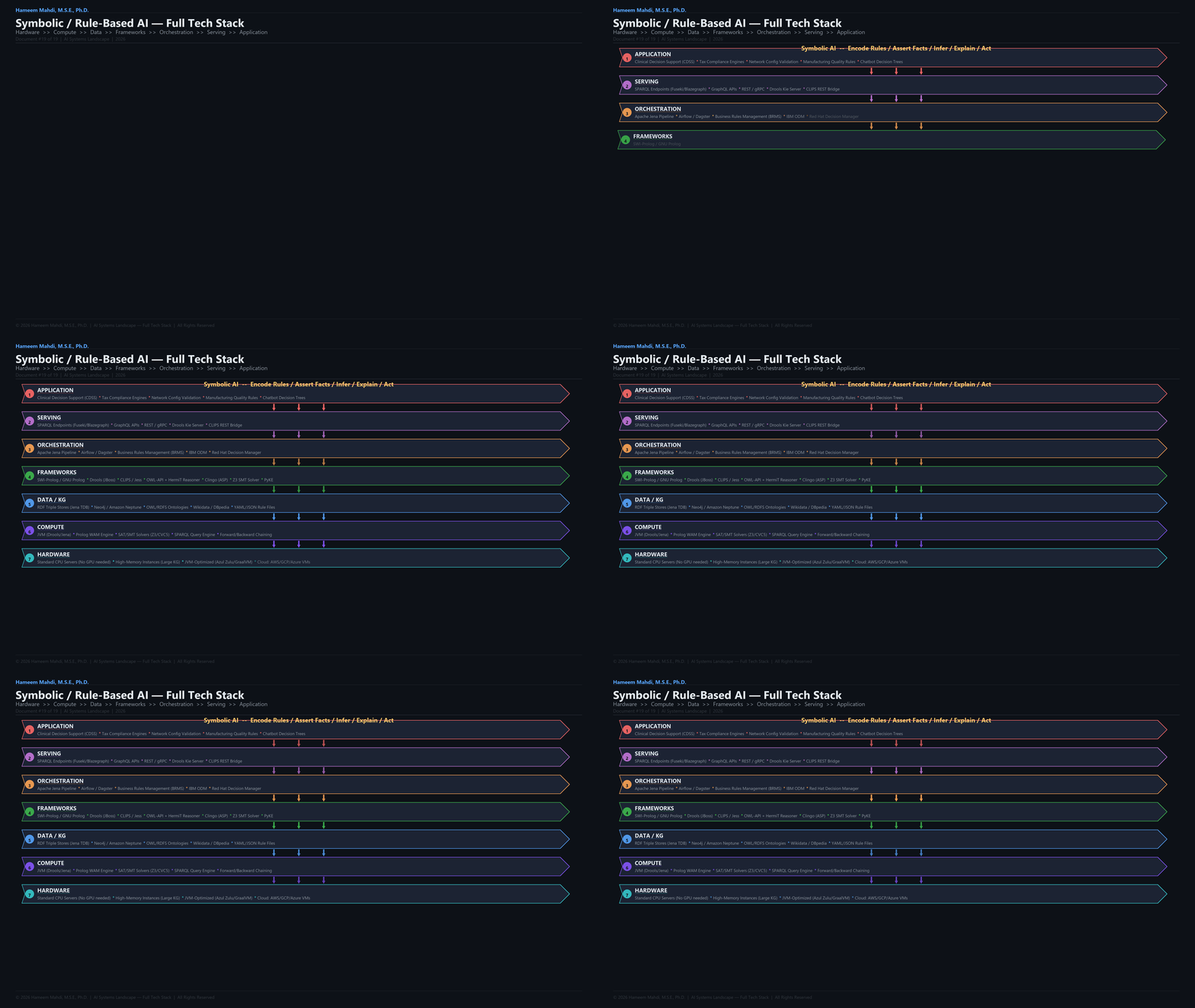
Animation infographics for Symbolic / Rule-Based AI — overview and full technology stack.

Regulation

Detailed reference content for regulation.

Regulation & Governance

Relevant Regulatory Context

Regulation Relevance to Symbolic AI
EU AI Act Symbolic AI's inherent explainability is a compliance advantage for high-risk applications
GDPR Article 22 Right to explanation for automated decisions — Symbolic AI can provide full reasoning traces
FDA Software as Medical Device (SaMD) Clinical decision support rules must be validated, documented, and version-controlled
Basel III/IV Banking regulators require explainable credit decision rules alongside model governance
SOX (Sarbanes-Oxley) Financial controls encoded as rules require audit trails and change management

Governance Advantages

Advantage Description
Full Traceability Every conclusion traces to specific rules and facts — ideal for audit
Version-Controlled Knowledge Rules can be versioned like code; every change is tracked
Deterministic Testing Same inputs always produce same outputs — straightforward to verify
Human-Readable Rules Rules are authored in human-understandable terms; no "black box"
Regulatory Mapping Rules can be directly linked to the regulation they implement

Governance Challenges

Challenge Description
Rule Proliferation Unchecked rule growth makes governance overhead unsustainable
Expert Bias Rules encode the biases and blind spots of the experts who wrote them
Provenance Tracking Knowing who wrote each rule, when, why, and based on what evidence
Cross-System Consistency Ensuring rules are consistent across multiple systems that encode overlapping domain knowledge

Deep Dives

Detailed reference content for deep dives.

Knowledge Representation & Ontologies

Ontology Design Principles

Principle Description
Clarity Terms should be defined objectively with formal, documented definitions
Coherence Axioms and definitions should be logically consistent; no contradictions
Extendibility New terms should be definable without revising existing definitions
Minimal Encoding Bias Conceptualisation should not depend on a particular representation language
Minimal Ontological Commitment Define only what is necessary; avoid unnecessary constraints on the world model

Major Ontologies

Ontology Domain Entities Used By
SNOMED CT Clinical medicine 350,000+ concepts NHS, US Federal Health IT, 40+ countries
Gene Ontology (GO) Molecular biology 44,000+ terms Genomics research worldwide
FIBO Financial services ~1,300 classes Banking regulatory compliance, data integration
Schema.org Web content ~800 types Google, Bing, Yahoo, Yandex — structured data markup
Dublin Core Metadata 15 core elements Digital libraries, document management
Wikidata General knowledge 100M+ items Wikipedia, academic research, AI systems

Knowledge Graph Architecture

┌──────────────────────────────────────────────────────────────────────┐
│ KNOWLEDGE GRAPH ARCHITECTURE │
│ │
│ ENTITIES RELATIONSHIPS ONTOLOGY │
│ ────────────── ────────────── ────────────── │
│ [Person: Einstein] ──born_in──► Classes: Person, │
│ [City: Ulm] ──works_at──► City, Theory │
│ [Theory: Relativity] ──developed──► Relations: born_in, │
│ works_at, developed │
│ │
│ TRIPLE STORE REASONER QUERY ENGINE │
│ ────────────── ────────────── ────────────── │
│ Subject-Predicate- Infers new triples SPARQL queries │
│ Object triples from ontology over stored + │
│ (RDF) axioms inferred triples │
└──────────────────────────────────────────────────────────────────────┘

Expert Systems — Architecture & Legacy

Classical Expert System Architecture

Component Role
Knowledge Base Contains the domain rules (IF-THEN) and factual assertions
Working Memory Stores the current case data and intermediate conclusions
Inference Engine Applies rules to working memory to derive new conclusions
Explanation Facility Traces the chain of rules used to reach any conclusion; answers "why" and "how" queries
Knowledge Acquisition Module Tools for domain experts to encode and validate rules
User Interface Dialogue system that gathers case information and presents recommendations

Landmark Expert Systems

System Year Domain Achievement
DENDRAL 1965 Chemistry First expert system; inferred molecular structure from mass spectrometry
MYCIN 1972 Medicine Diagnosed bacterial infections; outperformed junior doctors in studies
R1/XCON 1980 Computer hardware Configured DEC VAX computers; saved DEC $25M+/year
PROSPECTOR 1979 Geology Mineral deposit identification; guided discovery of a molybdenum deposit
CLIPS 1985 General NASA-developed expert system shell; widely used in research and education
Cyc 1984 Common sense Attempted to encode all common-sense knowledge; 25M+ assertions

The AI Winter and Lessons Learned

Issue Description
Knowledge Acquisition Bottleneck Extracting and encoding expert knowledge is slow, expensive, and error-prone
Brittleness Systems failed silently outside their narrow domain; couldn't say "I don't know"
Maintenance Burden Large rule bases became impossible to maintain, debug, or update safely
Scaling Failure Exponential complexity growth as rules interacted in unexpected ways
Overpromise Industry expectations exceeded what the technology could deliver, leading to disillusionment
Legacy Lessons directly inform modern AI governance: explainability, knowledge management, human-in-the-loop

Symbolic AI in the Modern Era

The Neuro-Symbolic Convergence

Approach Description
LLM + Knowledge Graph Ground LLM outputs in verified knowledge graph facts to reduce hallucination
Neural Theorem Proving Use neural networks to guide symbolic proof search (e.g., AlphaProof)
Ontology-Guided ML Use ontology structure to constrain and interpret ML model outputs
Symbolic Planning + Neural Execution Symbolic planner generates high-level plan; neural policies execute low-level actions
RAG with Structured Knowledge Retrieval-Augmented Generation pulling from knowledge graphs rather than unstructured text

Modern Use of Symbolic AI

Application How Symbolic AI Contributes
Regulatory Compliance Encode regulations as formal rules; automate compliance checking
Drug Discovery Biomedical ontologies (Gene Ontology, ChEBI) power knowledge-driven drug target identification
Enterprise Data Integration Ontologies provide semantic layers for integrating heterogeneous data sources
Question Answering Knowledge graphs power factual QA in search engines and virtual assistants
Configuration Management Constraint satisfaction solves complex product configuration problems
Formal Verification Mathematical proofs verify chip designs, safety-critical software, and smart contracts

Overview

Detailed reference content for overview.

Definition & Core Concept

Symbolic AI — also known as Rule-Based AI or GOFAI (Good Old-Fashioned AI) — represents the oldest and most established paradigm in artificial intelligence: the idea that intelligence can be achieved by encoding human knowledge as formal symbols, rules, and logic, then manipulating those symbols computationally to derive new knowledge.

Unlike statistical and neural approaches that learn patterns from data, Symbolic AI operates on explicitly stated knowledge. Every piece of reasoning is traceable back to the rules and facts that produced it. This makes Symbolic AI inherently transparent, auditable, and explainable — qualities that are increasingly valued in regulated industries.

Symbolic AI dominated the field from the 1950s through the 1980s, producing landmark systems like MYCIN, DENDRAL, and R1/XCON. While eclipsed by machine learning in many domains, Symbolic AI has experienced a significant resurgence as part of neuro-symbolic architectures that combine the learning power of neural networks with the reasoning rigour of symbolic systems.

Dimension Detail
Core Capability Codifies — encodes human knowledge as formal rules, logic, and ontologies, then reasons over them to derive conclusions
How It Works Knowledge graphs, production rules, first-order logic, ontologies, constraint solvers, semantic reasoners
What It Produces Logical inferences, explanations, classifications, diagnoses, constraint-satisfying solutions, knowledge-graph answers
Key Differentiator Knowledge is explicit and human-authored — every conclusion can be traced to the rules and facts that produced it

Symbolic AI vs. Other AI Types

AI Type What It Does Example
Symbolic / Rule-Based AI Reasons over human-authored knowledge to derive conclusions Medical expert system, legal reasoning engine
Agentic AI Pursues goals autonomously with planning and tool use Research agent, autonomous coding agent
Analytical AI Extracts insights and explanations from data Business intelligence, anomaly detection
Autonomous AI (Non-Agentic) Operates independently within fixed boundaries without human input Autopilot, auto-scaling, algorithmic trading
Bayesian / Probabilistic AI Reasons under uncertainty using probability distributions Clinical trial analysis, A/B testing, risk modelling
Cognitive / Neuro-Symbolic AI Combines neural learning with symbolic reasoning LLM + knowledge graph, physics-informed neural net
Conversational AI Manages multi-turn dialogue between humans and machines Customer service chatbot, voice assistant
Evolutionary / Genetic AI Optimises solutions through population-based search inspired by natural selection Neural architecture search, logistics scheduling
Explainable AI (XAI) Makes AI decisions understandable to humans SHAP explanations, LIME, Grad-CAM
Generative AI Creates new content from learned patterns GPT writing text, DALL-E generating images
Multimodal Perception AI Fuses vision, language, audio, and other modalities GPT-4o processing image + text, AV sensor fusion
Optimisation / Operations Research AI Finds optimal solutions to constrained mathematical problems Vehicle routing, supply chain planning, scheduling
Physical / Embodied AI Acts in the physical world through sensors and actuators Autonomous vehicle, robot arm, drone
Predictive / Discriminative AI Classifies or forecasts from statistical patterns in data Credit scoring, disease risk prediction
Privacy-Preserving AI Trains and runs AI without exposing raw data Federated hospital models, differential privacy
Reactive AI Maps current input to output with no reasoning or memory Thermostat, ABS braking
Recommendation / Retrieval AI Surfaces relevant items from large catalogues based on user signals Netflix suggestions, Google Search, Spotify playlists
Reinforcement Learning AI Learns optimal behaviour from reward signals via trial and error AlphaGo, robotic locomotion, RLHF
Scientific / Simulation AI Solves scientific problems and models physical systems AlphaFold, climate simulation, molecular dynamics

Key Distinction from Reactive AI: Reactive AI simply matches input to output with no reasoning chain. Symbolic AI performs multi-step logical reasoning — it derives new conclusions by chaining rules together and can explain its reasoning path.

Key Distinction from Predictive AI: Predictive AI learns statistical patterns from labelled data without explicit knowledge. Symbolic AI uses explicitly encoded knowledge and does not require training data — but equally, it cannot learn from data on its own.

Key Distinction from Generative AI: Generative AI produces probabilistic outputs from neural networks; its internal reasoning is opaque. Symbolic AI produces deterministic, fully traceable outputs from explicitly stated rules and logic.